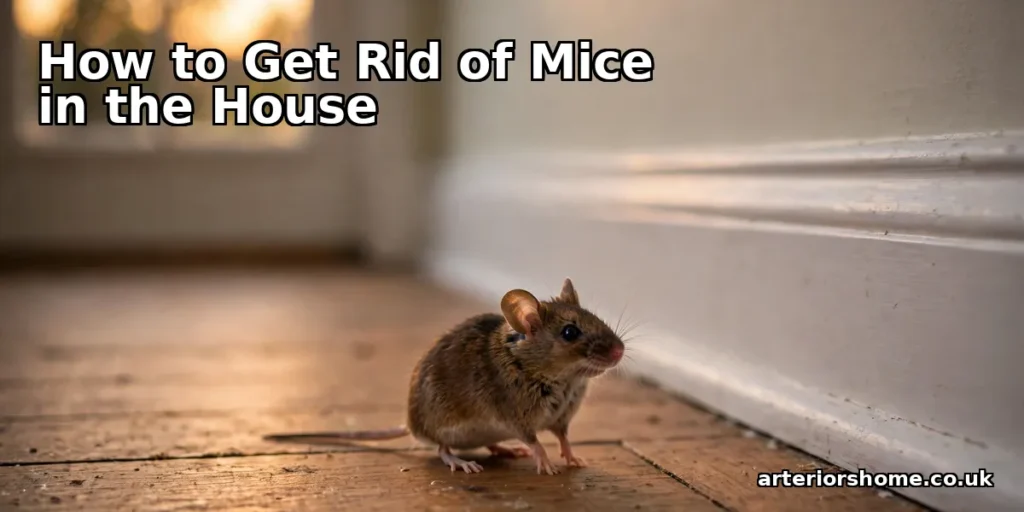
How to get rid of mice in house UK comes down to doing the right things in the right order: confirm it is mice, take the food away, trap what is already inside, then seal every way in.
Mice move indoors in autumn, when cold nights send them looking for warmth, food and somewhere to nest. The British Pest Control Association counts about 80,000 callouts for mice each year, and the animals stay active all winter, so the ones that move in during October are still there in February.
Most guides agree on the steps but disagree on two things: whether poison or traps should come first, and when glue traps became illegal. This guide settles both, with the real law dates for England, Wales and Scotland, and it walks through the job in the order a pest controller would use.
One evening starts the job and a weekend finishes it. The traps and sealing materials cost less than a single pest control visit, and our other Pest Control guides use the same approach: find the cause first, then fix it for good.
How to Get Rid of Mice in House UK in Seven Steps
This is how to get rid of mice in house UK, step by step, and the order matters more than the tools. Skip the last step and the mice come back. Seal too early and you trap them inside.
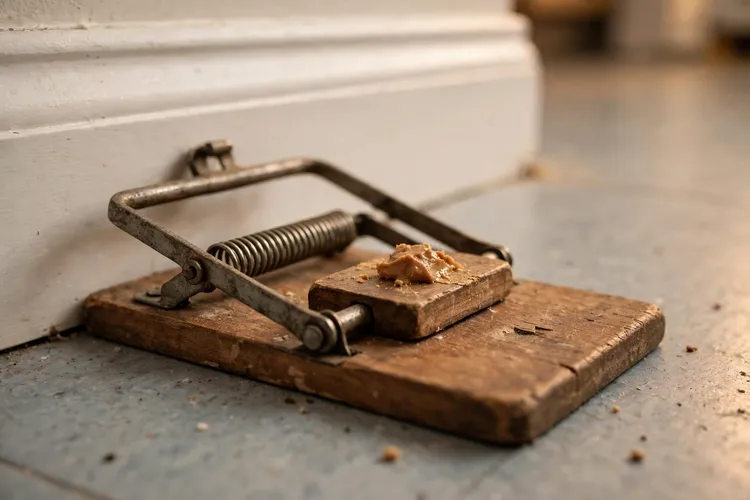
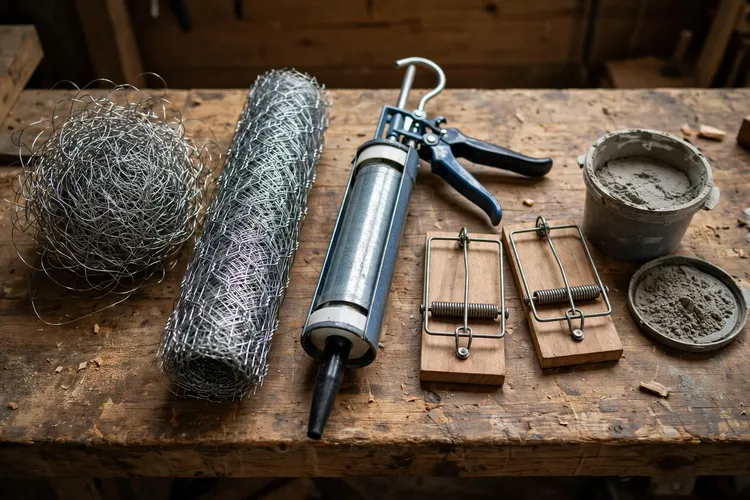
- Snap traps, 4 to 6: wooden break-back traps, the cheapest reliable option for a small problem.
- Peanut butter or chocolate spread: a pea-sized dab for bait. Cheese is a cartoon, not a bait.
- Disposable gloves: for traps, droppings and dead mice.
- Household disinfectant or bleach: for cleaning droppings safely.
- Steel wire wool and cement: for packing and sealing gaps mice cannot chew through.
- Galvanised mesh, 6 mm: for airbricks and vents.
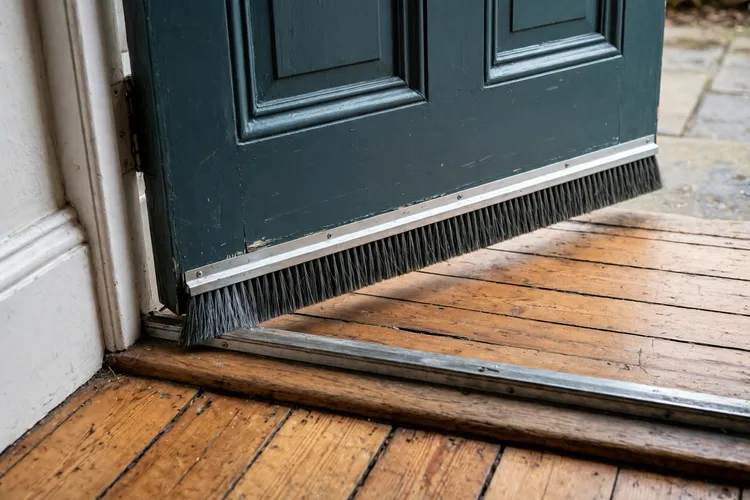
- Brush strips: for the gap under external doors.
1. Confirm it is mice
Droppings are the most reliable sign, and most people find them before they see a mouse. Check what you are finding against the table below, and note every room where you find signs, because the rooms tell you where the mice travel.
| Sign | What it looks like | Where to look |
|---|---|---|
| Droppings | Black, about the size and shape of a grain of rice, 3 to 6 mm long | Under the kitchen sink, around the boiler, in drawers and food cupboards |
| Gnawing | Small, neat tooth marks on packaging, skirting, cables and pipes | Food cupboards, behind appliances, under floors |
| Smell | A strong, stale, ammonia-like smell that builds over time | Enclosed spaces: cupboards, under the bath, the loft |
| Noise | Light, quick scratching and scurrying, mostly at night | Behind kickboards, in ceilings and stud walls |
| Nesting material | Shredded paper, fabric or insulation in a tight ball | Behind kitchen units, in airing cupboards, in the loft |
| Smears | Faint grey-black marks along the routes mice run | Along skirting boards and around holes |
One mouse can leave around 80 droppings a day, so a handful of droppings does not mean a handful of mice. If the droppings are noticeably bigger and thicker, you may be dealing with rats, not mice, and the treatment is different.
Three kinds of mouse commonly come indoors in the UK. The house mouse is small, light brown to grey and 60 to 90 mm long. The field mouse has sandy fur and a white-grey belly, and the yellow-necked mouse has a band of lighter fur around its neck.
2. Take the food away tonight
Mice make up to 30 short trips a night to food, so a few crumbs are enough to keep them going. Put every bit of food away tonight, in glass, metal or thick plastic containers, and include pet food, bird seed and the fruit bowl.
Bin anything they have chewed, then wipe the shelves and worktops. A clean kitchen is not just tidy, it makes the traps work, because bait is the best smell around when there is nothing else to eat. Our guide to cleaning a dishwasher covers the food and grease that builds up where mice feed.
3. Clean the droppings safely
Never sweep or vacuum mouse droppings. Sweeping puts virus particles into the air, and the diseases mice carry spread mainly through the air people breathe. Open the doors and windows for 30 minutes first, and leave the room while it airs out.
Put on rubber or plastic gloves, then spray the droppings with a household disinfectant or a fresh bleach solution, 1.5 cups of bleach per gallon of water. Let it soak for 5 minutes, wipe it up with paper towels, bag the towels, and wash your hands.
Throw out any food the mice have touched, even sealed packets with gnaw marks. Mice chew through thin plastic and card, and food that looks untouched may not be safe.
4. Set snap traps the right way
Snap traps are the best do-it-yourself option for a small, new problem. Set several, not one, because mice nibble a little from lots of places each night, and put a trap at every spot with droppings, plus a few more along each wall they use.
Bait each trap with a pea-sized dab of peanut butter or chocolate spread, or press a raisin onto the trigger. Set the trap at a right angle to the wall, trigger end touching the skirting board, because mice run along edges and rarely cross open floor.
Put traps where children and pets cannot reach them: behind the cooker, under kitchen kickboards, inside cupboards with droppings, or in a lockable trap box. Check them every morning, wear gloves to empty and reset them, and keep going until they stay empty and no fresh droppings appear.
5. Do not touch glue traps
Glue traps are not a household option any more. They cause long, slow suffering, they catch birds and pets as well as mice, and using one can now be a criminal offence. If you have old glue traps in a cupboard, do not set them. Bag them and put them in the household waste.
| Nation | Using a glue trap | Selling one |
|---|---|---|
| England | Offence since 31 July 2024, unless licensed by Natural England | Legal |
| Wales | Banned for everyone since 17 October 2023 | Legal |
| Scotland | Banned since 1 July 2026, along with owning one | Banned since 1 July 2026 |
| Northern Ireland | No restriction | Legal |
The dates matter because most guides still print the wrong ones. England’s ban came into force on 31 July 2024 under the Glue Traps (Offences) Act 2022, not in April. Scotland’s ban came into force on 1 July 2026 under the Wildlife Management and Muirburn (Scotland) Act 2024, not in August 2024.
In England, only a professional pest controller can hold a licence, and only in exceptional cases where every other method has failed, such as a hospital operating theatre or an aircraft. The government glue trap licence guidance sets out the two licence types and the training a controller needs.
6. Seal every gap, but only after the trapping stops
A house mouse can squeeze through a gap of around 6 mm, roughly the width of a pencil. Walk the full perimeter of the house at ground level and look low down as well as high up, because the gaps hide around pipes, under doors and behind the boiler.
Sealing is the step most people skip, and it is the step that decides whether how to get rid of mice in house UK works for good or only for a week. Seal too early, while mice are still inside, and you trap them in the house with no way out.
Pack small gaps with steel wire wool or copper mesh, then seal over it with exterior sealant or mortar. Mice chew through expanding foam and ordinary silicone on their own, so foam is only a filler behind something tougher, never the barrier itself.
Fit fine galvanised mesh over airbricks and vents, and fit brush strips on external doors where the gap is larger than 4 mm. Never block an airbrick completely. The underfloor void needs that ventilation, so cover the opening with mesh instead of sealing it shut.
7. Keep them out for good
A female mouse can be pregnant again within a day of giving birth, so every week you wait means more mice. Check the traps and the flour test every week through winter, and act the moment fresh droppings appear, not the month after.
The flour test is simple. Dust a thin line of flour along the skirting board before bed, and look in the morning. Tiny footprints in the flour mean mice are still using that run, and clean flour means the house is clear.
Keep the garden tidy too. Move log piles and stacked timber away from the walls, clear fallen fruit, and keep bird seed off the ground, because a fed mouse outside becomes a mouse inside when the nights turn cold.
Where Mice Get Into a House
Mice do not need an open door. They need a gap the width of a pencil, and finding those gaps is the first half of the job, because a sealed house stays sealed. These are the places to check first.
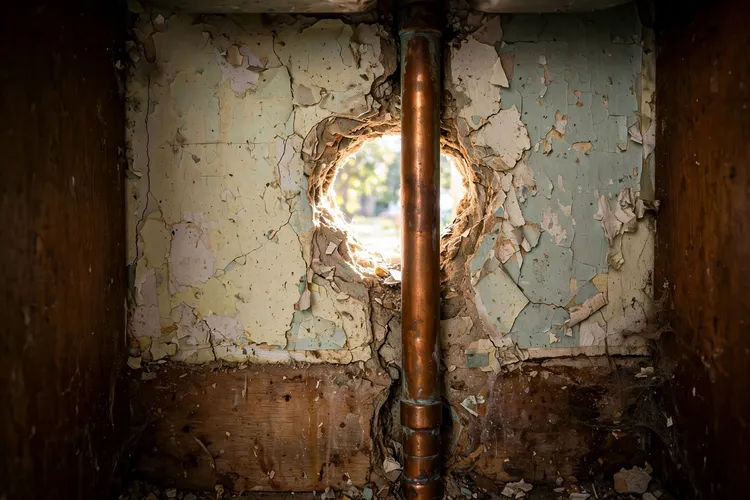
- Around pipes and cables: where water, waste and gas pipes pass through the wall, the hole is often cut bigger than the pipe and never filled.
- Airbricks with broken grilles: a cracked grille gives mice the whole underfloor void as a highway.
- Under external doors: a worn threshold or a dropped door leaves a gap at the bottom.
- Around the boiler flue: gaps where the flue and extractor ducts pass through the wall.
- The roofline: damaged or missing covers where the roof meets the wall let mice into the loft.
- Where extensions meet the house: the joint between old and new brickwork often opens up over time.
The roofline is easy to miss from the ground. Blocked or damaged gutters overflow and rot the boards mice climb through, so keeping them clear matters more than it looks. Our guide to cleaning gutters shows how to check them safely from a ladder.
Mice run along skirting boards, and the faint grey-black smear marks they leave show their routes. A fresh coat of paint will not hide them for long, and our guide to painting skirting boards is worth reading after the sealing is done, not before.
Traps, Poison and Repellents: What Actually Works
The argument about poison versus traps is where most guides split, and it is worth settling before you spend money. Snap traps suit a small, new problem. Poison suits a nesting problem, but it is slower, and it carries risks the traps do not.
| Method | Use it? | Why |
|---|---|---|
| Snap traps | Yes, first choice | Well-made ones kill instantly, cheap, reusable, no chemicals |
| Live-catch traps | Only for one or two mice | Mice can die in the trap, and released mice often come back |
| Poison | Last resort | Slow, often fails, and risks pets, children and other wildlife |
| Repellents and plug-ins | No | They do not remove mice already inside the house |
| A cat | No | It cannot reach mice under floors or inside walls |
| Glue traps | No, illegal | Banned for the public in England, Wales and Scotland |
| Professional treatment | Yes, if DIY is not enough | For mice in walls or several rooms, and for nesting mice |
Traps have their place with a shallow infestation, but they are not the answer once mice have nested. For nesting mice, a carefully positioned, small amount of rodenticide can work faster than traps.
The British Pest Control Association counts about 80,000 mouse callouts a year. Professional pest controllers have access to rodenticides that pose a lower risk to pets and children.
Peppermint oil and ultrasonic plug-ins are the two ideas that sound easy and do nothing. Mice may dislike the smell for a day, but a repellent does not remove mice already inside, and plug-ins will not reach mice under floors or inside walls.
Questions About Getting Rid of Mice

How fast can mice breed once they are inside?
Very fast. A female mouse can be pregnant again within a day of giving birth, and a single pair can become a dozen mice in a few months. That is why a week of waiting is never harmless, and why traps go down the night you find the first droppings.
Do ultrasonic plug-ins keep mice away?
No. They may bother a mouse for a day, but they do not remove mice already inside, and they will not reach the ones under the floor or inside the wall. Spend the money on traps and wire wool instead.
What should I do if I rent my home and find mice?
Tell your landlord first, in writing, with photos of the droppings and the gaps. Pest control in a rented home is usually the landlord’s job, not yours. Your local council’s environmental health team can also help, and some councils offer the service free.
Can I use poison if I have pets or children?
Only with great care, and often not at all. Loose poison risks pets, children and other wildlife, and a poisoned mouse can be eaten by a cat or an owl. Tamper-resistant bait stations are safer, but if you are unsure, call a professional pest controller.
How do I know the mice are gone?
When the traps stay empty and no fresh droppings appear for a week. Dust flour along the skirting boards for a few nights: clean flour means no mice are using that run. Keep checking for a month, because a sealed gap can open again.
Keep the House Mouse-Free
That is how to get rid of mice in house UK and keep it that way: confirm, clean, trap, seal, then check every week through winter. The job is not finished when the last trap is empty. It is finished when the house is sealed and the flour stays clean.
Walk the house once a month, and check the spare room and the loft where mice nest out of sight. Our spare room ideas show what a quiet room can become, and a room you use is a room mice avoid.
- Check the traps every morning: until they stay empty for a week.
- Flour test every week: along the skirting boards, through winter.
- Seal new gaps at once: pipes, doors and airbricks, before mice find them.
- Keep food sealed: glass or metal containers, pet food included.
- Call a professional: if mice are in the walls, in several rooms, or the traps stop working.