One day your backyard is quiet. The next, it sounds like a power tool convention moved in next door.
If you’ve just stepped outside into a wall of buzzing, clicking noise and a yard full of large, red-eyed insects clinging to every surface, you’re not imagining things. This is a cicada emergence, and during a periodical brood year, it can feel like a full-on invasion.
Here’s the good news first: cicadas don’t bite, sting, or carry diseases. They’re not after your prized flowers, your vegetable garden, or your peace of mind on purpose. They’re just loud, clumsy, and everywhere for a few weeks.
You don’t need to wipe out every cicada in your yard. That’s not realistic and it’s not necessary. Your real goal is simpler: protect your young trees, keep them off your patio and pool, and get through the next few weeks without losing your mind. Here’s exactly how to do that.
Why Are Cicadas in Your Yard? (The Quick Context)
Before jumping into solutions, it helps to know what you’re actually dealing with.
Annual cicadas show up every summer in smaller numbers. You’ve probably heard their drone in the background for years without thinking much of it.
Periodical cicadas are the ones causing the chaos. These broods spend 13 or 17 years underground as nymphs, feeding quietly on tree root sap, then emerge all at once by the billions. It’s a rare, synchronized event, and it’s the reason your yard suddenly feels like ground zero.
Once they’re above ground, cicadas have one job: mate, lay eggs in tree branches, and die. The entire adult cycle wraps up in about four to six weeks. They’re not interested in your house, your food, or your garden beds. They’re interested in trees, and each other.
6 Safe Methods to Get Rid of and Manage Cicadas
You can’t stop an emergence. What you can do is manage where cicadas gather and protect what matters most. Here are six methods that actually work.
1. Protect Vulnerable Trees With Netting
Female cicadas lay eggs by cutting small slits into pencil-sized branches. This process, known as “flagging,” causes the branch tip beyond the cut to wilt and turn brown. Mature, established trees can usually shrug this off, but young saplings and newly planted ornamentals don’t have the extra branches to spare.
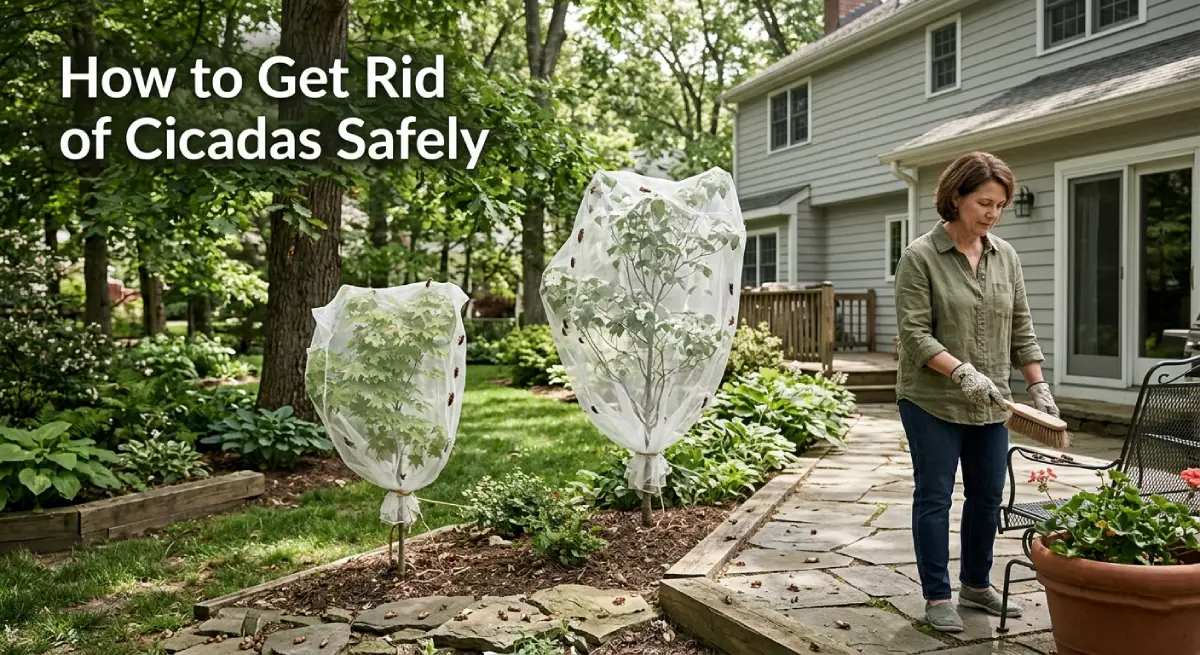
How to do it: Wrap saplings and small decorative shrubs in fine insect netting or tulle, with a mesh size of around 1/4 inch or smaller so cicadas can’t squeeze through. Tie the netting securely around the trunk so they can’t crawl up from below. Leave it in place through the emergence window and remove it once the adults have died off, usually by late June or early July depending on your region.
2. Use a Garden Hose for Physical Eviction
Sometimes the simplest fix is the best one. A firm blast from a garden hose will knock cicadas off patio furniture, walls, railings, and low branches without harming them. It’s not a permanent fix since more will land again, but it’s an easy way to clear a space before you sit outside or host guests.
3. Keep Up With Lawn Care and Pruning
Tidy, consistent yard maintenance does double duty here.
Keeping your grass mowed and your yard free of excess debris makes the ground less inviting for nymphs as they eventually burrow back down. It won’t stop the emergence, but it keeps things tidier overall.
The more important step is pruning. If you spot branches with fresh egg slits or flagging, cut them off and dispose of them (don’t compost them in place near the tree) before the eggs hatch. Eggs typically hatch about six weeks after being laid, and removing damaged branches early reduces how many nymphs make it back into your soil to start the next cycle.
4. Wrap Tree Trunks With Sticky Tape
This method targets nymphs as they climb tree trunks to molt into adults. A band of sticky tape wrapped around the trunk can catch them on their way up.
A caution worth noting: wrap the tape sticky-side out, but place a layer of cloth, burlap, or another barrier between the tape and the bark itself. Adhesive applied directly to the trunk can damage the bark over time, so this method needs a little extra care to avoid trading one problem for another.
5. Pick Them Off by Hand
For smaller yards or a handful of prized plants, this is about as direct as it gets. Cicadas are slow, clumsy fliers and easy to catch. Pick them off (wearing gloves if you’d rather not touch them) and drop them into a bucket of soapy water. It’s not glamorous, but for targeted protection of a specific plant, it’s genuinely effective.
6. Invite Natural Predators
Birds, squirrels, raccoons, and moles all treat a cicada emergence like an open buffet, and they’ll happily do some of the work for you.
Putting out bird feeders or a birdbath can draw more birds into your yard during peak emergence. It won’t eliminate the population (there are simply too many cicadas for predators to make a dent in the overall numbers), but every cicada eaten is one less in your space.
What NOT to Do: The Chemical Myth
It’s tempting to reach for pesticides when your yard is overrun, but spraying is one of the least effective responses you can choose.
Why pesticides fail: Periodical cicadas emerge in such overwhelming numbers that spraying barely makes a dent. Even pest control professionals generally don’t recommend it, since cicadas from untreated areas nearby will simply fly in to replace the ones you killed. Their short above-ground lifespan also means chemical treatments would need constant reapplication to have any real effect.
The collateral damage: Pesticides don’t discriminate. Spraying can kill beneficial pollinators like bees, and it can poison the birds, raccoons, and other predators that eat treated cicadas. You end up doing more harm to your yard’s ecosystem than the cicadas themselves ever would.
The official guidance from agricultural extensions and environmental agencies is consistent on this point: skip the spray.
How to Protect Your Home and Pets
Inside the house: Keep doors and windows shut as much as possible during peak emergence, and check window screens for holes or gaps. Cicadas aren’t trying to get inside, but an open door is an easy invitation.
Pool maintenance: Cicadas are terrible swimmers. If your pool is uncovered during an emergence, expect to find them floating in it regularly. Skim daily and keep your pool covered when it’s not in use to avoid clogged filters and a buildup of debris.
Dog and cat safety: Cicadas aren’t toxic to pets, and a few nibbled here and there generally won’t cause problems. The concern is volume. Their exoskeletons are tough and don’t digest easily, so a pet that gorges on a large number of them can end up with an upset stomach, vomiting, or diarrhea. In rare cases, eating too many can lead to a digestive blockage. Keep an eye on outdoor time during peak weeks, and call your vet if your pet shows ongoing vomiting, lethargy, or discomfort after a cicada binge.
Conclusion: The Silver Lining
As overwhelming as it feels in the moment, a cicada emergence is genuinely temporary. The noise, the swarms, the constant crunch underfoot, all of it winds down within about four to six weeks as the adults finish mating and die off.
There’s also a quiet upside. As cicadas decompose, their bodies release nitrogen and other nutrients into the soil, giving it a small natural boost. It’s not a dramatic transformation, but it is a real, documented part of how these emergences feed back into the ecosystem they’re part of.
So protect your young trees, hose down your patio furniture, keep pets supervised, and ride it out. In a few weeks, your yard will be quiet again, and you’ll have several more years (often well over a decade) before the next brood comes knocking.