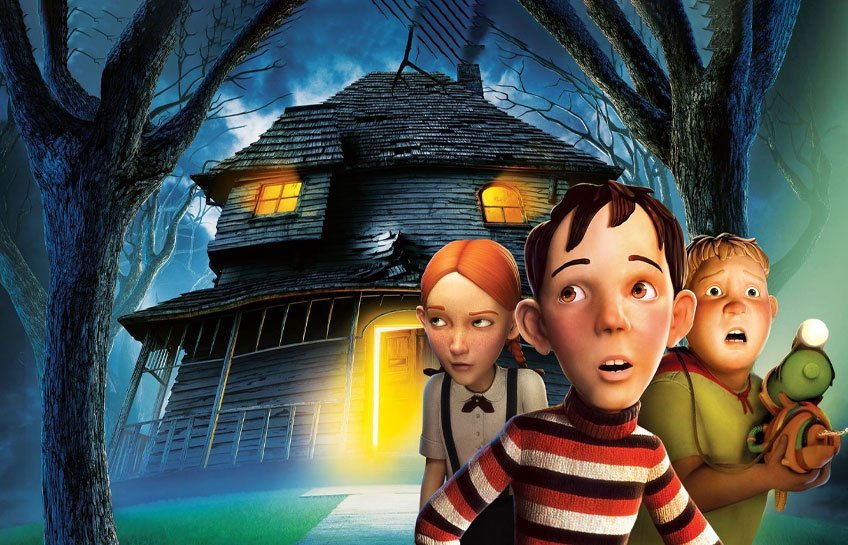
What Is the Chowder Monster House?
The Chowder Monster House refers to the central setting and villain of Sony Pictures’ 2006 animated horror-comedy film Monster House, in which a chubby, candy-loving 12-year-old named Charles “Chowder” Peterson and his best friend DJ investigate a terrifying, living house owned by grumpy neighbor Horace Nebbercracker. The house is not just haunted, it is literally alive, a “domus mactabilis” (Latin for “deadly home”), powered by the trapped soul of Nebbercracker’s late wife, Constance. The film became a cult classic and earned nominations for both the Academy Award and Golden Globe for Best Animated Feature.
From a real estate and architectural standpoint, the Monster House is one of animation’s most analyzed residential structures. It presents as a decayed, late Victorian-style wooden home on a quiet American suburban street, but its anatomy functions like a living organism. The windows act as eyes, the front door becomes a mouth lined with jagged wooden boards as teeth, the red carpet is a tongue, and the basement is the stomach. Below is a quick breakdown of its key story and structural features:
| Feature | Details |
|---|---|
| Property Type | Victorian-era single-family wooden house |
| Location | Suburban American neighborhood (1980s setting) |
| Owner | Horace Nebbercracker |
| Possessing Spirit | Constance Nebbercracker (“The Giantess”) |
| Heart/Core | The basement furnace |
| Key Weakness | Destroying the furnace (its heart) |
| Main Hero | Charles “Chowder” Peterson |
| Film Release | July 21, 2006 |
| Box Office | $142 million worldwide |
Who Is Chowder from Monster House?
Charles “Chowder” Peterson is DJ Walters’s comical, dim-witted, and pudgy best friend, and the deuteragonist of the Monster House film. He is a timid, stubborn, and sometimes immature 12-year-old with a passion for trick-or-treating. Chowder serves as the film’s comic relief but also its emotional anchor, bringing an authentic sense of pre-teen friendship and loyalty that keeps the story grounded even as the horror ramps up. His name is a nickname, and he prefers to introduce himself as “Charles” when trying to impress girls, which becomes one of the film’s most charming running jokes.
Chowder is known to be comical, goofy, and somewhat immature, which can annoy DJ and other people, such as Jenny. He really loves candy and junk food, based on his chubby appearance. In addition, Chowder is shown to be well-mannered and civil when he introduces himself as Charles after first meeting Jenny, indicating he knows how to act like a gentleman sometimes. Despite playing the fool for much of the film, Chowder proves himself genuinely brave at the climax, climbing into an excavator at the construction site and fighting the house that has broken free from its base, famously shouting: “Hey, House… I’m gonna renovate you!”
| Detail | Information |
|---|---|
| Full Name | Charles “Chowder” Peterson |
| Age | 12 years old |
| Film | Monster House (2006) |
| Role | Deuteragonist / Comic relief |
| Voice Actor | Sam Lerner |
| Best Friend | DJ Walters |
| Love Interest | Jenny Bennett |
| Signature Trait | Loves candy, junk food, trick-or-treating |
| Key Skill | Operating heavy machinery (excavator) |
| Character Design | Troy Saliba, DJ Hauck, John J. Meehan |
Where Does Chowder Live in Monster House?
The story takes place in a quiet suburban American neighborhood the day before Halloween, where three middle schoolers, DJ (the paranoid one), Chowder (the snack-obsessed comic relief), and Jenny (the brain of the group) discover that the spooky house across the street is alive, cranky, and ready to throw down. Chowder lives near DJ on the same residential street, close enough to visit daily. The neighborhood is set in the 1980s based on several production design clues, with wide lawns, single-family homes, and the kind of mid-century American suburban layout where everyone knows their neighbor’s business.
The street is dominated by the Nebbercracker property, which sits directly across from DJ’s home and casts a shadow over the whole block. As crisp orange leaves blanket DJ’s suburban neighborhood the day before Halloween, his portly pal Chowder ponders what costume he’ll wear on the big day. It is the kind of street where kids ride bikes and sell candy door-to-door, making the Monster House’s predatory presence all the more disturbing by contrast.
The Monster House Exterior: A Masterclass in Animated Horror Architecture
The design on the house is impressive, transforming an old wooden house into a vicious monster. The Nebbercracker house draws heavily from deteriorating Victorian residential design, a style that already carries cultural associations with decay and menace. Its clapboard siding is warped and darkened, its roof sags in the middle, and its porch boards are uneven and splintered. The overall silhouette is asymmetric in a way that feels wrong without being obviously cartoonish.
What makes the architectural design so effective is that its windows are eyes. The front door opens into a gaping maw lined with cracked boards for teeth. And its tongue, a long red carpet, lashes out at trespassers, dragging them across the threshold. This transformation from suburban bungalow to biological predator is the film’s central visual achievement. The house does not need to look like a monster to be terrifying. It looks like a neglected home, and that familiarity is exactly what makes it so unsettling.
Exterior Features:
- Warped Victorian-style clapboard siding in dark, weathered tones
- Asymmetric roofline suggesting structural instability
- Overgrown front lawn functioning as the house’s “territory”
- Front porch with jagged broken boards forming teeth-like protrusions
- Two upper-floor windows functioning as the house’s eyes
- Central chimney (connected to the furnace heart) constantly emitting smoke
Inside the Monster House: Rooms That Breathe, Bite, and Swallow
The interior of the Nebbercracker house is one of the most detailed and frightening domestic spaces in animated film history. The windows (the eyes) light up, the door (the mouth) opens and sharp boards break out of the top and bottom (the teeth) and into the house the floorboards break open (the throat) leading to the basement (the stomach), the carpet rises from the stairs (the tongue is the carpet).
Each room of the house has a functional equivalent in a living body:
| Room/Feature | Biological Equivalent | Function in the Film |
|---|---|---|
| Front Door | Mouth | Opens to consume victims |
| Red Carpet / Stairs | Tongue | Lashes out to grab people |
| Floorboards | Throat | Breaks open to swallow prey |
| Basement | Stomach | Holds captured items and remains |
| Furnace | Heart | Power source and vulnerability |
| Chimney | Lungs | Emits smoke when the house is active |
| Chandelier Uvula | Uvula | Jenny uses this to force the house to vomit |
| Windows | Eyes | Glow to show awareness and emotion |
The Basement: Dark Secret at the Heart of the Property
DJ, Chowder, and Jenny fall into the basement and find an enormous collection of toys accumulated from Nebbercracker’s lawn, as well as a locked cage that DJ opens with a key he found on the lawn. They find the body of Constance, Nebbercracker’s wife, encased in cement. This basement functions simultaneously as the house’s stomach, its trophy room, and its most emotionally devastating space. Decades of confiscated toys, bikes, kites, and balls fill it like a strange museum of neighborhood childhood.
The locked cage within the basement is a direct callback to Constance’s tragic origin. A giantess in a traveling freak show, she had been ridiculed and abused for a long time before meeting her husband, Mr. Nebbercracker, who ended up being the silver lining of her life, and her of his. The basement holds her skeletal remains encased in a concrete mass, a grim reminder that the house is built on grief and trauma. From a real estate perspective, it is the structural and emotional foundation of everything above it.
The Furnace: Why the Heart of a House Matters
The furnace is the Monster House’s most important architectural feature because it is the seat of Constance’s soul. They learn that the house is a “domus mactabilis” (Latin for “deadly home”); a monstrous being created when a human soul merges with a structure. They assume the house is inhabited by Nebbercracker’s soul. The only way to kill the house is to destroy its heart; its source of life. They conclude that the heart must be the fireplace, as DJ realizes that the chimney has been smoking since Nebbercracker died.
In real property terms, the furnace sits in the most protected part of the structure: the basement, below grade, surrounded by concrete and inaccessible without navigating the entire house first. This is both good horror writing and surprisingly accurate architecture. Boilers and furnaces in older Victorian homes were placed centrally in basements to distribute heat evenly, making them physically central to the structure, which the filmmakers turned into a brilliant metaphor.
Monster House: Real Estate Portfolio and Property Analysis
While the Monster House is a fictional property, its design carries real residential value signals worth analyzing through a property lens:
| Property Feature | Description | Estimated Real-World Impact |
|---|---|---|
| Lot Size | Large corner suburban lot with expansive lawn | High value in 1980s suburban market |
| Architectural Style | Deteriorating late-Victorian wooden construction | Value-negative due to deferred maintenance |
| Basement | Full basement with concrete encasement | Structural concern; would require disclosure |
| Chimney | Active, double-flue masonry chimney | Functional but poorly maintained |
| Location | Quiet residential street, suburban neighborhood | Positive market signal |
| Condition | Severe neglect, structural damage | Would require major renovation |
| Special Hazard | Possessed by vengeful spirit | Non-standard disclosure item |
The Nebbercracker home, if assessed as a standard property, would likely be flagged as a distressed listing with significant structural concerns. The deferred maintenance, damaged porch, overgrown lawn, and basement encasement would all require disclosure under standard real estate law. Its lot size and location, however, would give it underlying land value in any suburban American market.
Other Notable Fictional Houses Chowder Explores
While the Monster House is the only property Chowder directly interacts with in the film, the Monster House universe establishes several other residential structures:
| Property | Owner/Occupant | Key Feature | Role in Film |
|---|---|---|---|
| DJ Walters’ Home | DJ’s parents | Standard suburban two-story | Observation post |
| Chowder’s Home | Peterson family | Near DJ’s street | Starting point for adventure |
| Construction Site | Unnamed developer | Crane, excavator, foundation pit | Climax battle location |
| Nebbercracker House | Horace Nebbercracker | Living, sentient Victorian home | Main antagonist |
| Pizza Parlor | Skull (Reginald Skulinski) | Video game zone, backroom | Information source |
Celebrity Comparison: Other Iconic Fictional and Real Houses
Based on coverage from arteriorshome.co.uk, two other notable residential properties share thematic or architectural connections with the Monster House:
| Feature | Monster House (Chowder) | Patrick Star House | James Rolfe House (AVGN) |
|---|---|---|---|
| Property Type | Victorian wood-frame house | Undersea rock formation | Real suburban home/studio |
| Owner | Horace Nebbercracker | Patrick Star | James Rolfe |
| Special Feature | Living, sentient structure | Interior larger than exterior | Legendary gaming Nerd Room |
| Cultural Status | Animated horror icon | SpongeBob fan favorite | YouTube content creation landmark |
| Architecture Style | Decayed Victorian | Natural rock, organic | Suburban with studio conversion |
| Emotional Core | Grief, protection, love | Simplicity, friendship | Nostalgia, creativity |
| Audience | Family/horror fans | Children, animation fans | Retro gaming community |
Patrick Star’s Rock: Patrick Star’s rock house is one of the most recognizable homes in animated television, sharing the Monster House’s quality of being a residential space that defies normal architectural logic from the inside.
James Rolfe House: The James Rolfe House has become legendary among gaming enthusiasts and YouTube fans worldwide. This creative sanctuary serves as more than just a home, it’s the birthplace of countless Angry Video Game Nerd episodes that have entertained millions.
FAQs
Q1: Why does Chowder’s basketball start the whole story in Monster House?
Chowder paid $28 for the basketball by raking yards and asking his mom for money. When it lands on Nebbercracker’s lawn, DJ tries to recover it, triggering the chain of events that wakes the house.
Q2: Is the Monster House actually evil?
No. The house isn’t an entirely malicious force; it is incredibly protective of Nebbercracker and only becomes violent when someone threatens him or the property.
Q3: How does Chowder defeat the Monster House at the end?
Chowder starts up an excavator at the construction site and battles the house, causing it to fall into a pit, while DJ throws dynamite into the chimney to blow it up.
Q4: What does “domus mactabilis” mean in Monster House?
It is Latin for “deadly home,” the term used to describe a structure possessed by a human soul that turns it into a living monster.
Q5: Who voices Chowder in Monster House?
Chowder was motion captured and voiced by Sam Lerner in the 2006 animated film.
Q6: Was Monster House based on a real house?
No. Monster House was initially set up at DreamWorks Animation SKG, based on a pitch by newcomer Gil Kenan, who added the concept of a soul possessing a structure.
Final Words: Why the Chowder Monster House Still Matters
Nearly two decades after its release, the Chowder Monster House remains one of the most architecturally and emotionally complex settings in animated film. The house works because it takes something deeply familiar, a tired old Victorian home at the end of the street, and makes it genuinely dangerous. Chowder, as the film’s most human and relatable character, gives audiences a way into that fear.
Monster House is one of those films that people in their 20s watched when they were young and were either traumatized by or didn’t know what to make of it. That reaction is earned. The film treats grief, trauma, love, and suburban architecture as interconnected forces, and it does so through the eyes of a candy-obsessed 12-year-old who just wanted his basketball back. From a real estate lens, the Nebbercracker property is the ultimate distressed listing: structurally compromised, legally complex, and sitting on top of a tragic story no disclosure form could fully capture.