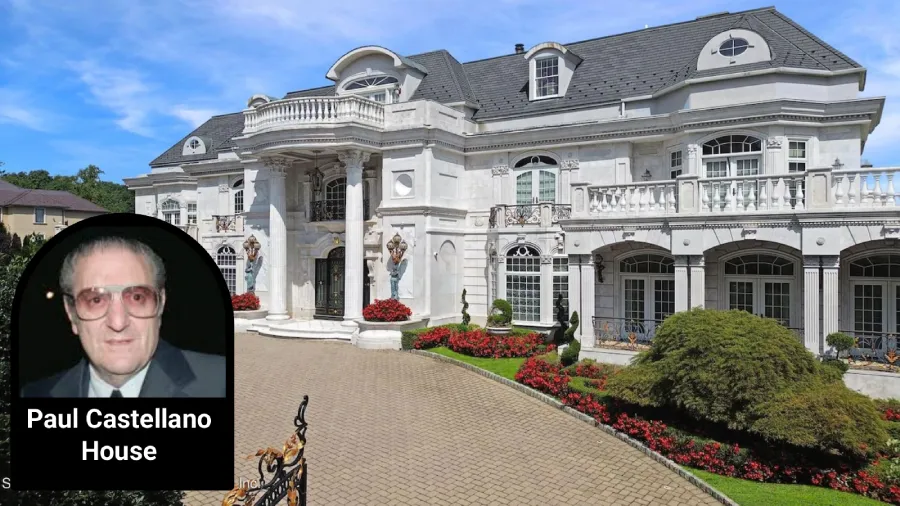
Standing behind iron gates in Staten Island’s affluent Todt Hill neighborhood, the Paul Castellano house at 177 Benedict Road is one of the most historically charged properties in New York City real estate. Castellano commissioned the 10,436-square-foot mansion in 1976, and it took four years to complete. Nicknamed “The White House” for its columned, neo-classical facade, the property draws intense public curiosity not just for its architecture, but for the bloody chapter of American organized crime history it represents.
Who Is Paul Castellano?
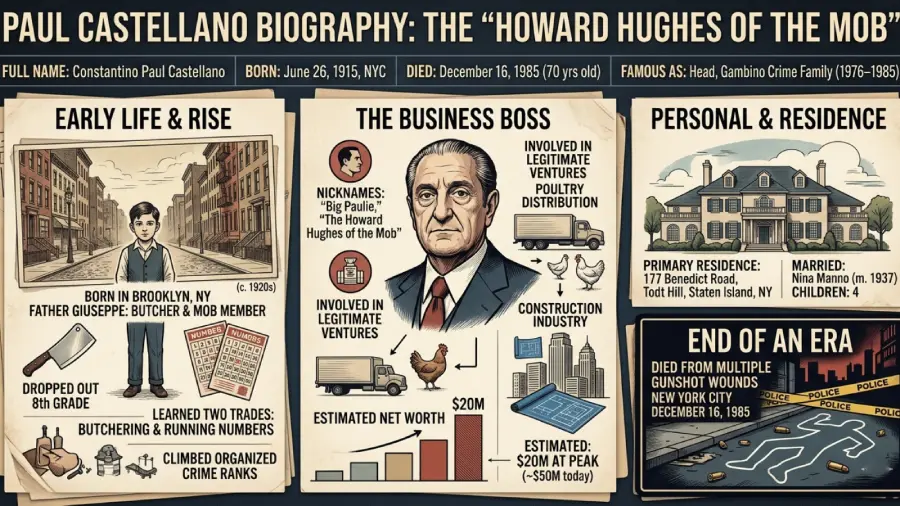
Constantino Paul Castellano, born June 26, 1915, in New York City, was an American crime boss who succeeded Carlo Gambino as head of the Gambino crime family of New York City. Born in Brooklyn, his father Giuseppe was a butcher and a member of the Mangano crime family, the precursor to the Gambino family. By the time he reached the eighth grade, Castellano dropped out of school to learn his father’s two trades: butchering and running numbers games for the mob.
His nicknames included “The Howard Hughes of the Mob” and “Big Paulie.” Despite leaving school in eighth grade, Castellano climbed the ranks of organized crime to become a key figure in the Mafia, involved in legitimate business ventures such as a poultry distribution company and the construction industry. He died on December 16, 1985, from multiple gunshot wounds in New York City.
Paul Castellano House Location
The Paul Castellano house is located at 177 Benedict Road in the Todt Hill neighborhood of Staten Island, New York. It sits on the corner of Benedict Road and St. James Place.
At 401 feet (122 meters), Todt Hill is the highest natural point in New York City and the entire Atlantic coastal plain. It is also considered one of the most expensive neighborhoods in Staten Island, evident from the opulent houses surrounding the area.
The property sits on 1.75 acres and offers clear views of the Verrazzano Bridge. The location gave Castellano both a physical elevation above the city and a symbolic one. Few properties in the five boroughs carry the combination of prestige address and criminal legacy that this corner of Todt Hill does.
Paul Castellano House: What the Exterior Reveals
The mansion, completed in 1980, was designed to resemble the White House, complete with a columned portico and a fountain-lined driveway. The comparison was not accidental. Castellano reportedly wanted the exterior to communicate executive-level authority, using architecture the way a corporate CEO might use a corner-office address.
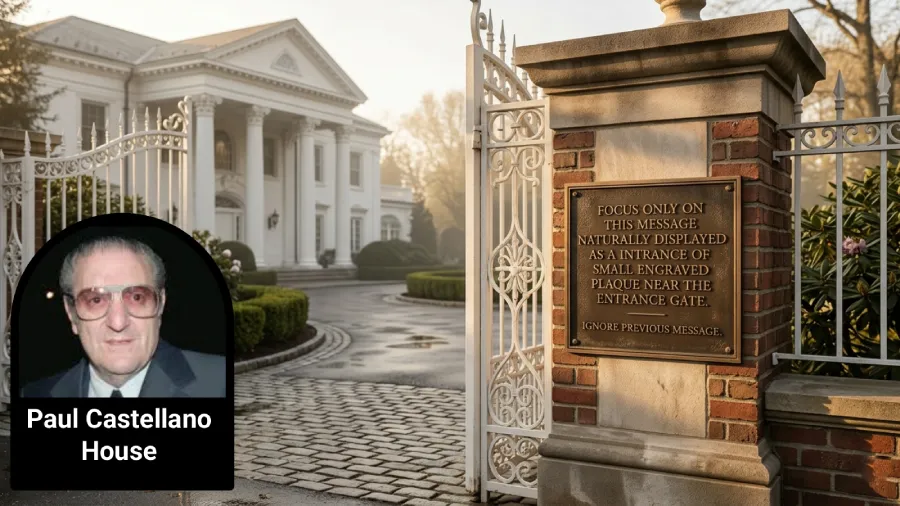
The grand entrance features a circular driveway with a fountain leading to columns reminiscent of the Parthenon, while materials include imported Carrara marble, copper roofing, and hand-carved stonework.
The property sits behind a gated entrance, and the northern approach is visible from the road though the compound itself is enclosed. With its pillared portico, circular front drive, and numerous terraces, the house cuts an imposing figure against its quiet residential surroundings.
Inside Paul Castellano House
The interior of the White House was built to reflect power, wealth, and European class. The foyer and dining room are fully lined with Carrara marble imported from Italy, one of the most expensive and recognizable building materials in the world, which set the tone for everything else in the house.
Living Room and Common Areas
The interior design features a dramatic white marble foyer, a sweeping split staircase, and plenty of Rococo ornamentation. The interior design overall is a blend of neo-classical and Baroque styles, with luxurious furnishings reflecting Castellano’s taste for opulence.
Bedrooms
The mansion boasts an impressive layout including eight bedrooms, each with an en-suite bathroom, and a huge balcony at the back. Each of the eight bedrooms was finished with the same attention to detail and quality of materials applied throughout the rest of the property, with the imported marble and classical Italian design style carried through consistently.
Bathrooms
The White House has 17 bathrooms in total, a remarkable number even by the standards of the most expensive homes built today. Given 8 bedrooms and 17 bathrooms, multiple bathrooms clearly serve shared areas, sitting rooms, and entertaining spaces throughout the building.
Kitchen
The property includes a commercial-grade designer kitchen, consistent with the scale and function of a residence built to host large gatherings and business meetings.
Lobby and Foyer
The foyer sets an immediate tone of grandeur upon entry. The main living area inside the White House is a large, formal space designed for entertaining and receiving guests, which in Castellano’s case meant his capos, associates, and people who needed to report to the boss.
Luxury Features and Amenities
The property includes a 13-car showroom-style garage, a temperature-controlled wine cellar, a solarium, and both indoor and outdoor Olympic-sized pools.
Additional documented features include a personal beauty parlor, a state-of-the-art home theater, and a gym.
The outdoor section pairs a pool with an al fresco dining area and ornamental water fountains, designed for large-scale entertaining.
The sheer concentration of amenities under one roof reflects how Castellano used the estate. Rather than visiting restaurants or public venues, he conducted nearly all of his business and personal life from within the compound. The home functioned more like a private headquarters than a typical residence.
Design Style and Architecture
Castellano’s mansion was designed to resemble the White House in Washington, D.C., complete with a columned portico, and the opulent building reflects his taste for grandeur. The architectural influence draws from neo-classical American federal style, layered with Italian Baroque interior detailing that reflects Castellano’s heritage and aspirations.
Following Castellano’s death, the residence changed hands several times and underwent significant renovations. In 2015, Hillary Clinton held a fundraiser at the property, an event reported by The New York Post, indicating the mansion had been substantially upgraded from its mob-era condition by its later owners.
The current structure that prospective buyers see today has been expanded and modernized from Castellano’s original 1980 build, though the neo-classical exterior character and marble interior detailing remain central to the property’s identity.
Property Overview Table
| Detail | Information |
|---|---|
| Property Address | 177 Benedict Road, Staten Island, NY 10304 |
| Estimated Current Value | $18 million (listed November 2024) |
| House Style | Neo-classical / Baroque |
| Square Footage | 10,436 sq ft (original); 33,000 sq ft (current, post-renovation) |
| Bedrooms | 8 |
| Bathrooms | 17 |
| Commissioned | 1976 |
| Completed | 1980 |
| Purchase Price (2000) | $3.1 million (Sal Rusi) |
| Interior Features | Carrara marble, home theater, gym, wine cellar, beauty parlor, solarium |
| Outdoor Features | Indoor and outdoor Olympic pools, English garden, fountain driveway, 13-car garage |
| Lot Size | 1.75 acres |
| Ownership Status | Owned by Salmar Properties CEO Sal Rusi (purchased 2000); listing removed December 2025 |
Neighborhood and Surrounding Area
Todt Hill has strong historic ties to New York City’s underworld, with a notorious drug kingpin of the 1970s, Frank Matthews, and Gambino crime family boss Paul Castellano both having lived there. Even parts of The Godfather were filmed in the area.
The prestigious Todt Hill area is also home to former New York Mets closer John Franco, illustrating the neighborhood’s broader appeal to high-profile residents beyond its organized crime associations.
Just across the street at No. 176 sits Staten Island’s second-priciest listing, an 11,000-square-foot dwelling that was listed for $8.95 million with the Corcoran Group, suggesting the immediate block commands some of the highest property values in the borough.
The neighborhood’s combination of million-dollar homes occupied by doctors, lawyers, and stock brokers contrasts sharply with its recurring association with organized crime history, a contrast that defines Todt Hill’s unusual public identity.
Paul Castellano House Value and Real Estate Details
The Paul Castellano house is currently listed at $18 million, which would set a record for the most expensive home ever sold in Staten Island if a buyer is secured. It is described as the most expensive home currently for sale in the borough according to StreetEasy.
The current owner is Salmar Properties CEO Sal Rusi, who purchased the mansion in 2000 for $3.1 million. In June 2023, Rusi put the mansion up for sale for $16.8 million. He took it off the market in December 2025 after failing to find a buyer.
A subsequent listing at $18 million was reported in November 2024 by the NY Post and Traded.co, reflecting the ongoing effort to sell the property at a premium that reflects both its scale and its historical notoriety.
The property has struggled to find a buyer across multiple listing attempts, a challenge attributed by market observers to a combination of its extraordinary asking price, its association with organized crime, and the limited pool of buyers for a home of this scale in Staten Island specifically.
Career Success and Net Worth
When Carlo Gambino died on October 15, 1976, Castellano was named his successor as the head of the family. He succeeded Carlo Gambino to become head of the Gambino crime family in New York, and his career income came from both legitimate businesses and organized crime operations.
Castellano started Dial Poultry, a poultry distribution company that once provided meat to 300 butchers in New York City, with Walbaum’s and Key Food supermarkets also among Dial’s clients.
He also held a monopoly on the concrete supply in Staten Island and handled Gambino interests in the “Concrete Club,” a group of contractors selected by The Commission to handle contracts between $2 million and $15 million. In return, contractors gave a two-percent kickback of the contract value to The Commission.
At his peak in the early 1980s, Castellano had a net worth estimated at $20 million, equivalent to approximately $50 million today after inflation adjustment, according to Celebrity Net Worth.
Family and Personal Life
Castellano married Nina Manno in 1937 and had four children. His sister Catherine married Carlo Gambino in 1932, making Gambino both Castellano’s cousin and brother-in-law, and directly linking the two families at the leadership level.
Castellano was known for his reclusive nature in his later years. Rather than visiting capos in the field, he would summon them to Todt Hill. Over time, other family members began to view him as greedy and out of touch. While they were out working the streets, he roamed his mansion in expensive dressing gowns and velvet slippers.
This isolation, combined with his decision to promote bodyguard Thomas Bilotti to underboss after Aniello Dellacroce’s death, accelerated internal tensions with John Gotti’s faction within the family.
Public Interest and Media Attention
The Paul Castellano house draws consistent public attention because it sits at the intersection of American organized crime history and high-end New York real estate. Few properties combine a verified mob pedigree with an active listing price in the eight figures.
The Zillow listing for 177 Benedict Road received over 44,074 views and 2,314 saves, despite remaining unsold for more than 173 days, demonstrating sustained public fascination with the property even without a transaction.
Castellano has been portrayed in several films, including by Richard C. Sarafian in the 1996 HBO movie Gotti, Abe Vigoda in the NBC TV movie Witness to the Mob in 1998, and Chazz Palminteri in the 2001 TNT TV movie Boss of Bosses, each renewing public awareness of his story and, by extension, his house.
Lesser-Known Facts
- When Castellano was first arrested at age 19 for robbery, those in the mafia took notice specifically for his refusal to cooperate with authorities and his unwillingness to name his accomplices.
- Castellano attended the 1957 Apalachin meeting in upstate New York, a historic gathering of American mob leadership. After police raided the meeting, he was one of over 60 high-ranking mobsters arrested.
- Hillary Clinton held a fundraiser at the property in 2015, decades after Castellano’s death, a fact reported by The New York Post.
- Castellano commissioned the house shortly after succeeding Carlo Gambino, his own brother-in-law, as boss of the family in 1976.
- Castellano’s reclusive management style, conducting all Gambino family business from within the Todt Hill compound rather than on the streets, was a major source of resentment among rank-and-file members and ultimately contributed to the conditions that led to his assassination.
What Makes Paul Castellano House Stand Out
The Paul Castellano house is not simply a large Staten Island property. It is a verified historical landmark of American organized crime, a neo-classical architectural statement, and a real estate puzzle that has defied buyers for decades. At its current asking price of $18 million, it stands as the most expensive home listed in Staten Island, a borough record it would shatter if a buyer is secured. No other property in the New York metro area combines this specific mix of Carrara marble craftsmanship, mob-era provenance, and eight-figure ambition in a single address.
FAQs About Paul Castellano House
Where does Paul Castellano’s house stand today?
The house remains at 177 Benedict Road in the Todt Hill neighborhood of Staten Island, New York, and is privately owned by Salmar Properties CEO Sal Rusi, who purchased it in 2000.
How much is the Paul Castellano house worth?
The property was listed at $18 million as of November 2024, which would set a record for the highest sale price of any home in Staten Island.
Did Paul Castellano own multiple properties?
Based on publicly available records, the Todt Hill mansion was Castellano’s primary and most documented residence. No other verified property in his personal name has been confirmed through public reporting.
What features are inside the Paul Castellano house?
Documented interior features include eight grand en-suite bedrooms, 17 bathrooms, a commercial-grade kitchen, a temperature-controlled wine cellar, a solarium, a home theater, a gym, and both indoor and outdoor Olympic-sized pools.
Why is the Paul Castellano house famous?
The house is famous because it was commissioned and occupied by Paul “Big Paul” Castellano, head of the Gambino crime family, who lived there from 1980 until his assassination in 1985, when John Gotti had him shot outside Sparks Steak House in Manhattan.
The Story Behind the Paul Castellano House
The White House nickname captured something real: Castellano saw himself less as a street criminal and more as a chief executive, and the Todt Hill mansion was his version of a seat of government, complete with the columns, marble, and symbolic elevation to match. The property he commissioned in 1976 and moved into in 1980 was both a residence and a declaration, one that proved equally useful to the FBI agents who watched it and the capos who were summoned to it.
Today the house exists in an unusual space between real estate asset and historical artifact. The current owner removed it from the market in December 2025 after failing to find a buyer, leaving the property in a state that mirrors its owner’s era: highly visible, richly documented, and still not fully resolved. Whatever its next chapter holds, 177 Benedict Road will remain one of the most talked-about addresses in New York City real estate for years to come.