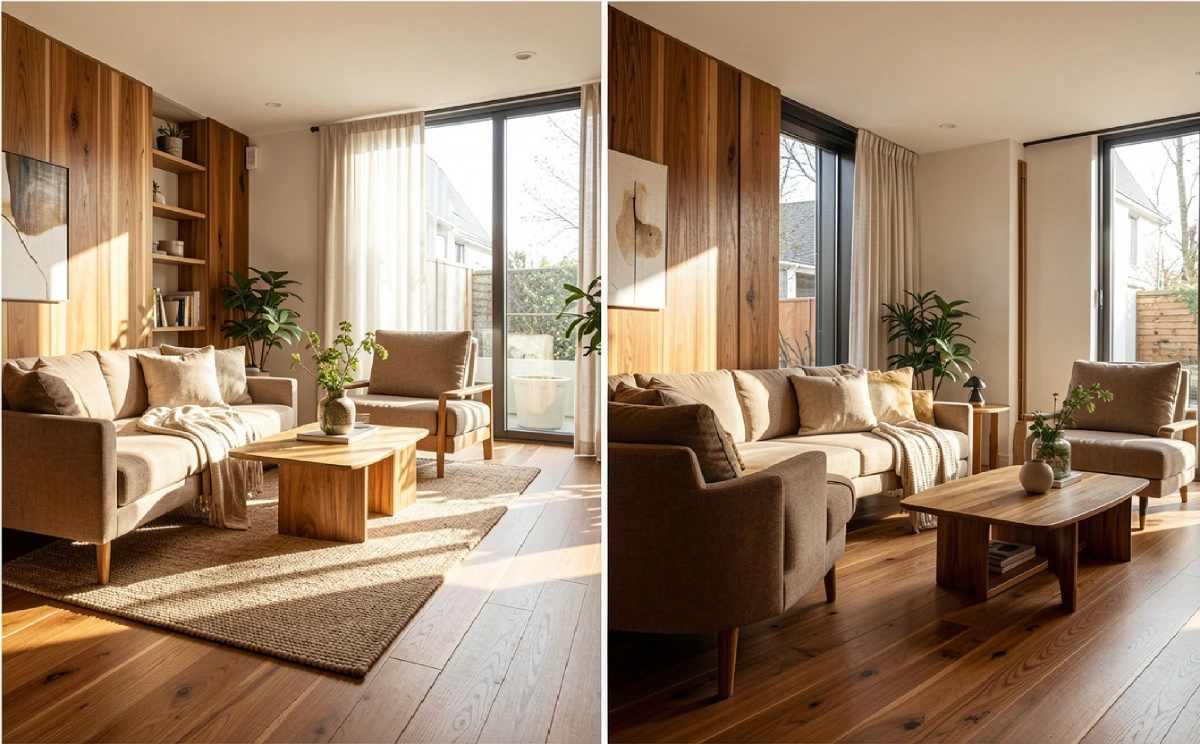
Picking between vinyl flooring and hardwood usually starts as a style decision. You like the look of wood, you like the price or practicality of vinyl, and you assume the answer will reveal itself pretty quickly. Then you start comparing durability, moisture, resale value, maintenance, indoor air quality, and long-term wear, and the decision suddenly gets a lot less obvious.
The truth is, neither one is automatically “better.” The better floor is the one that fits the way your home actually functions. If your house deals with wet shoes, pets, spills, kids, and heavy daily traffic, your priorities will be very different from someone remodeling a formal living room or trying to maximize long-term resale appeal. Hardwood remains a highly desirable feature for buyers, with NAR highlighting NAHB survey data showing hardwood flooring among the home features rated “essential” or “desirable” by 80 percent or more of buyers. At the same time, resilient flooring, which includes vinyl, remains enormously popular and is second only to carpet in floor covering sales in North America.
Start with the biggest difference: real wood vs synthetic surface
Hardwood is real wood on the surface you walk on. NWFA defines a wood floor as a flooring product that contains real wood as the top-most wearable surface, and it breaks wood flooring into solid, engineered, and composite engineered categories. That matters because when you choose hardwood, you are choosing a natural material that brings real grain, texture, and aging characteristics into the home.
Vinyl flooring is part of the resilient flooring category. Depending on the product, it may come in planks, tiles, or sheets, and many vinyl floors are built in layers, including a wear layer and a printed visual layer designed to imitate wood or stone. In other words, hardwood is the real thing, while vinyl is the practical imitator that has gotten much better at copying the look.
When vinyl makes more sense
If your home has a lot of moisture, vinyl usually gets the first serious look for a reason. RFCI says resilient flooring is moisture-resistant, naturally stain-resistant, and easy to clean, with spills that can simply be wiped away. It also notes that resilient flooring has an impervious surface that is affected very little by surface spills and heavy wet-mopping. That makes vinyl a very practical choice in homes where the floor needs to deal with water, mess, and constant cleanup without drama.
Vinyl also tends to win in homes where low-maintenance living matters more than material prestige. RFCI describes resilient flooring as durable, easy to maintain, easy to install, and available in a wide range of colors and patterns. Consumer Reports’ recent flooring testing also found that vinyl is among the flooring types that hold up especially well against scratches and dents in high-traffic conditions. That does not mean vinyl is indestructible, but it does help explain why it keeps showing up in busy family homes, rentals, mudrooms, and utility-heavy spaces.
There is also the budget question. RFCI explicitly frames resilient flooring around durability, affordability, and style. That does not give a universal price tag, because brands and installation methods vary a lot, but it does reflect the real-world reason many homeowners start with vinyl in the first place: it is often the easier upfront purchase when the project budget is tight.
When hardwood makes more sense
Hardwood makes the strongest case when you care about authenticity, long-term character, and resale appeal. There is a reason it keeps coming back to the top of homeowner wish lists. NAR notes that wood floors are once again high on many homeowners’ wish lists, and its coverage of NAHB data shows hardwood flooring remains one of the home features buyers strongly want. In plain English, people still see wood floors as a premium feature.
Hardwood also has a long-game advantage that vinyl does not really compete with in the same way. NWFA notes that when wood floors begin to look dull, they can be renewed through recoating. Proper maintenance helps them perform for the lifetime of the floor, and NWFA specifically describes wood floors as something worth protecting as an investment. That is one of hardwood’s biggest strengths. It is not just a surface you use up. It is a material that can be refreshed and kept going when it is chosen well and cared for properly.
Then there is the resale side. NAR has cited wood flooring as having the greatest positive impact on home resale value in most cases, referencing an estimated 118 percent return on investment from its 2022 Remodeling Impact Report. That does not mean every wood floor project will pay back the same way in every neighborhood, but it does reinforce hardwood’s reputation as the more value-forward choice when resale is part of the conversation.
The maintenance question is more important than people think
This is where a lot of flooring decisions become very real.
Hardwood is not fragile, but it is less forgiving of moisture. NWFA recommends routine sweeping, dust mopping, or vacuuming, says spills should be cleaned immediately with a dry or slightly damp cloth, and warns against wet mops or steam mops because they can damage the finish and the wood over time. That tells you a lot right there. Hardwood is manageable, but it asks for a little respect.
Vinyl is usually the easier day-to-day floor for messy households. RFCI says resilient flooring does not trap dirt and dust the way some other surfaces do, is moisture resistant, and can be damp-mopped as needed. If your household includes pets coming in from the yard, children dropping juice, or people who do not want to worry every time water hits the floor, vinyl has a very real, practical edge.
Durability is not as simple as people think
A lot of homeowners hear “hardwood” and assume it must be tougher because it is wood. Others hear “vinyl” and assume it is cheap plastic that will fall apart. Both assumptions miss the point.
Hardwood is durable, but it is still wood. It can show dents, scratches, and wear depending on species, finish, traffic, and lifestyle. NWFA’s maintenance guidance makes it clear that wear patterns depend on use and household conditions. Hardwood ages, and sometimes that aging looks beautiful. Sometimes it just looks worn.
Vinyl, especially better-quality products, often performs very well in abuse-heavy environments. Consumer Reports’ recent testing puts vinyl among the strongest performers against scratches and dents in high-traffic areas, and RFCI emphasizes the role of the wear layer in resilient flooring performance. So if your main concern is survival under rough everyday use, vinyl has a strong case. If your main concern is aging with dignity and preserving a premium look over time, hardwood has a stronger emotional and visual argument.
Indoor air quality and material standards should not be ignored
This is the part buyers often skip because it is less exciting than stain color, but it matters.
For vinyl and other resilient flooring products, one useful checkpoint is FloorScore. RFCI explains that FloorScore certification means a flooring product has been independently certified by SCS to comply with VOC emissions criteria under California Section 01350. If you are shopping for vinyl, looking for FloorScore-certified products is a smart filter, especially in bedrooms, nurseries, or tightly sealed homes where indoor air quality matters. RFCI also notes that people spend around 90 percent of their time indoors, which is exactly why this question matters.
For hardwood products that include composite elements, such as some engineered constructions or related finished goods, EPA says composite wood products, such as hardwood plywood, MDF, and particleboard, sold in the United States must be labeled TSCA Title VI compliant. Those standards exist to limit formaldehyde emissions. So if you are buying engineered wood or composite-core products, it is worth checking the labeling rather than assuming all products are built the same way.
Which rooms usually favor one over the other
In real life, this choice often becomes easier when you stop asking, “Which floor is best?” and start asking, “Best where?”
Vinyl usually makes more sense in laundry rooms, basements, entry-heavy spaces, and homes where moisture and cleanup are part of the daily routine, because resilient flooring is designed around moisture resistance and easy maintenance. Hardwood usually makes more sense in living rooms, bedrooms, dining spaces, and homes where warmth, real material character, and buyer appeal matter more than spill resistance. That room-by-room logic is partly an inference, but it follows directly from the maintenance and moisture characteristics laid out by NWFA and RFCI.
So, which is best for your home
If your top priorities are moisture resistance, low maintenance, scratch resistance, and staying on a tighter budget, vinyl is usually the better fit. It is the practical choice, and for many households, practical wins.
If your priorities are real material, long-term character, renewability, and stronger resale appeal, hardwood is usually the better fit. It asks for a little more care, but it gives you something vinyl cannot fully duplicate: the feel and status of actual wood underfoot.
The mistake is thinking there is one universal winner. There is not. The best floor is the one that matches your daily life, not the one that wins the loudest argument in a showroom.