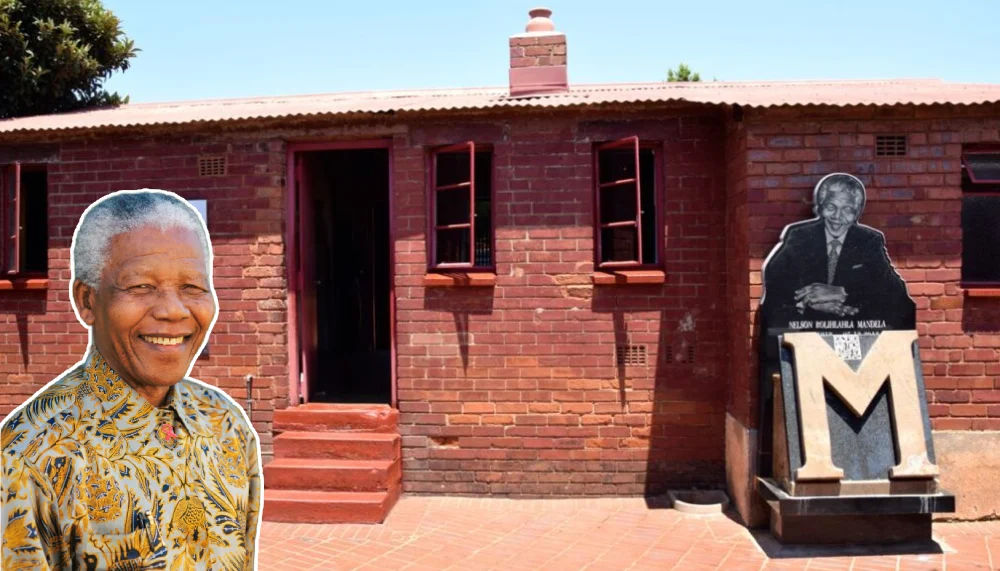
Mandela Home sits at the corner of Vilakazi and Ngakane Streets in Orlando West, Soweto, Johannesburg. It’s the modest four-roomed red-brick home where Nelson Mandela lived from 1946 to 1962, and it’s now one of the most visited historic sites in all of Africa. Small in size but enormous in meaning, this single-storey house carries the full weight of South Africa’s struggle for freedom.
You won’t find a mansion here. What you will find is something far more powerful. Every room tells a story, every wall bears a scar, and every exhibit speaks to the life of a man who changed the world from one of the humblest houses on earth.
Who Is Nelson Mandela?
Nelson Rolihlahla Mandela was born on 18 July 1918 in the village of Mvezo in the Eastern Cape, South Africa. He grew up in the Xhosa-speaking Thembu royal household and became the first in his family to receive a formal education. As a lawyer, activist, and leader of the African National Congress, he spent 27 years in prison before emerging to lead his nation as its first democratically elected Black president in 1994.
His presidency from 1994 to 1999 transformed South Africa’s political landscape after decades of apartheid. Mandela later received the Nobel Peace Prize in 1993, shared with F.W. de Klerk, and became a global symbol of reconciliation, dignity, and the refusal to surrender hope.
| Detail | Information |
|---|---|
| Full Name | Nelson Rolihlahla Mandela |
| Born | 18 July 1918 |
| Birthplace | Mvezo, Eastern Cape, South Africa |
| Occupation | Lawyer, Activist, Statesman, President |
| Known For | Leading the anti-apartheid movement; first Black President of South Africa |
| Education | University of Fort Hare; University of the Witwatersrand (LLB) |
| Net Worth | Est. $10 million USD at time of death |
| Current Residence | Passed away 5 December 2013; laid to rest in Qunu, Eastern Cape |
| Social Media | Official legacy maintained at @NelsonMandela |
| Notable Achievement | Nobel Peace Prize, 1993; President of South Africa, 1994–1999 |
Mandela Home Location: Orlando West, Soweto, Johannesburg
Mandela House is located at 8115 Vilakazi Street, Orlando West, Soweto, Johannesburg, at the corner of Vilakazi and Ngakane Streets. The address itself has become one of the most recognised in South Africa. Vilakazi Street is noteworthy as the only street in the world that has been home to two Nobel Peace Prize laureates: Nelson Mandela and Archbishop Desmond Tutu. The vibrant street is a cultural hub, lined with restaurants, shops, and other historical sites.
Soweto — an abbreviation of South Western Townships — is Johannesburg’s most famous township and a destination that draws visitors from across the globe. The Orlando West neighbourhood where Mandela House stands represents the beating heart of that community. These were houses built in 1945 by the Johannesburg City Council as affordable housing for Black families under apartheid restrictions, and yet they became the cradle of South Africa’s liberation movement.
Vilakazi Street stretches a little over 450 metres and is arguably the most famous road in South Africa. That’s a remarkable claim for a street this short, but every metre of it has earned that title.
Mandela House Tour: Walking Through Number 8115
Stepping up to 8115 Vilakazi Street, the first thing that strikes you isn’t grandeur. It’s the opposite, and that’s exactly the point. Walking up to 8115 Vilakazi Street, the first thing that strikes you isn’t grandeur, but profound modesty. It’s a small, four-roomed house, not much different from its neighbours.
As I walked through the entrance, the air felt different. There’s an immediate sense of weight here, like the walls are holding something more than just history books. The concrete floors catch your footsteps. The corrugated roof is visible from inside. The house has been returned to its former humble, three-roomed layout, with concrete floors and the corrugated roof visible from inside. Nothing feels staged. Everything feels real.
The garage has been converted into the ticket hall, which is where guided tours begin. Staff at Mandela House allow 20 visitors in at a time for ease of access. That limit is intentional. It keeps the experience intimate rather than turning it into a crowded spectacle.
Interior of Mandela House
Living Area
The living room is small but full of presence. The living room displays original furniture and personal items. Family photographs line the walls, showing intimate moments from the Mandela family’s daily life. You’re not looking at replicas here. These are the actual items that filled this space during one of the most turbulent and vital periods in South African history.
The photographs are striking. They show a younger Mandela, a family man, a lawyer — not yet the global icon the world came to know. That contrast is what makes this room so quietly powerful.
Bedrooms
The museum exhibits original furnishings from the family’s occupancy, including items that furnish the modest living and sleeping quarters to reflect mid-20th-century domestic conditions. These displays use period-authentic materials and fabrics preserved from the site’s history, emphasising the spatial constraints such as the small bedroom where a double bed dominated the room.
Think about that. A double bed filling the room. No walk-in wardrobe, no ensuite, no luxury. This is where one of the most significant leaders of the 20th century started every morning. It reframes everything you thought you knew about greatness and where it comes from.
Bathrooms
The bathroom reflects the modest conditions of 1940s and 1950s township housing. Period-appropriate fixtures have been preserved as part of the restoration effort, giving visitors an accurate sense of the daily domestic reality the Mandela family navigated during the apartheid era.
Kitchen and Dining Area
The kitchen remains largely unchanged, with period-appropriate appliances and utensils. It’s a kitchen that speaks of daily life continuing despite surveillance, raids, and fear. The property includes original kitchen appliances and furniture. There’s something grounding about seeing where a family simply ate and lived, separate from the drama of history.
Exterior and Outdoor Space
Step outside and the story becomes even more visible. The house is a single-storey red-brick matchbox built in 1945. It has bullet holes in the walls and the facade has scorch marks from attacks with Molotov cocktails. Those marks haven’t been removed. They’re part of the site’s testimony.
The mango tree, a prominent feature in the yard, is often pointed out as a silent witness to history. It stood there as children played beneath its shade, as visitors came and went, and as state security cars circled the block. That tree has outlasted apartheid itself. It’s still there.
In order to make the house into a museum, the garden has been concreted over and photos and text added to the walls, while the garage has become the ticket hall.
Mandela Home Key Features
- Four inter-leading rooms across a compact single-storey layout built in 1945 by the Johannesburg City Council
- Red-brick matchbox construction, a standard township design of the era, now a protected National Heritage Site
- Bullet holes and petrol bomb scorch marks still visible on exterior walls from apartheid-era police raids
- Original concrete floors and corrugated iron roof, fully preserved after the 2009 R9-million restoration
- Period-authentic furniture and household items restored using archaeological findings and archival records
- Mandela’s personal boot collection, displayed on a shelf and among the most visited exhibits in the house
- Honorary doctorate collection on display, representing global recognition of Mandela’s contribution
- A boxing belt gifted by Sugar Ray Leonard, among the more unexpected personal items on exhibit
- A multicoloured cloak presented to the former president, displayed as part of the gifts and tributes section
- Family photographs from the 1950s, including intimate Mandela family portraits rarely seen in textbooks
- Interactive visitor centre added during the 2009 renovation, featuring film, sound, and interpretive panels
- Study exhibit including Mandela’s desk, legal documents, and books from his time as a practising lawyer
- Guided tours in English, limited to 20 visitors at a time for an intentionally personal experience
- Cashless ticketing system, with entry fees ranging from R40 to R180 depending on age and visitor origin
Personal House Touches
Here is the thing about Mandela House that most articles miss entirely. It’s not a cold museum full of rope barriers and clinical labels. It reflects a living, breathing family home. The boots on the shelf, yes, but also the photographs of daughters Zenani and Zindzi growing up in these rooms. The legal papers in the study. The kitchen table where ordinary meals happened alongside extraordinary decisions.
Key artifacts include family photographs dating to the 1950s, personal memorabilia like honorary doctorates conferred on Nelson Mandela, and artwork depicting the Mandelas’ experiences.
What stands out is how the home connects Mandela the activist with Mandela the father and husband. His legal career shows up in the study. His international standing shows up in the gifts from world leaders. His humanity shows up in the boots.
Famous Neighbors Near Vilakazi Street, Soweto
Archbishop Desmond Tutu
Tutu House is located on Vilakazi Street in Soweto, Johannesburg, and was the home to Desmond and Leah Tutu. Desmond Tutu and his family moved into this house in 1975. His property sits a short walk from Mandela House, painted light grey and enclosed by high walls. Tutu, as he is fondly known, is said to stroll the streets when he is in town. The Nobel Peace Prize laureate chose this neighbourhood because it was his community, his people, and his calling. Vilakazi Street is well known as the only street with two Nobel Prize winners, namely Bishop Desmond Tutu and the first Black President of South Africa, Nelson Mandela.
Winnie Madikizela-Mandela
After divorcing Nelson Mandela, Winnie Madikizela-Mandela turned the home into the Mandela Family Museum and started a restaurant and pub across the road. She maintained a separate property a short walk from number 8115 for years. Winnie was a towering figure in the anti-apartheid movement in her own right, raising the couple’s daughters in this street while Nelson was imprisoned and she herself was banished to Brandfort in the Free State in 1977.
Hector Pieterson — Memorialised Nearby
On the corner of Moema and Vilakazi Street is the intersection where Hector Pieterson was killed by apartheid police. Pieterson was the first victim of the June 16 students’ uprising, a key event in the struggle against apartheid. A museum and memorial bearing his name now stands close to that spot. The image of him, captured by photographer Sam Nzima, sent shockwaves around the world. His story is inseparable from this street’s identity.
Where Does Nelson Mandela Currently Live?
Nelson Mandela passed away on 5 December 2013 at the age of 95 in Johannesburg. As President of South Africa, Mandela’s private residence was the Mandela Mansion in Houghton Estate, Johannesburg, a property that after his death went into the Zindzi Mandela Family Trust.
He was laid to rest on 15 December 2013 at Qunu in the Eastern Cape, the village where he spent much of his childhood. The Vilakazi Street house remains open as a public museum under the management of the Soweto Heritage Trust.
Market Value and Comparisons
The R9-million restoration was undertaken by Soweto Heritage Trust, with donations from Standard Bank and Anglo American of R2.25 million each. Restoration work commenced on 18 July 2008 to mark Mandela’s 90th birthday, and the house was re-opened in a formal exclusive launch on 19 March 2009.
The property itself is not a commercial asset in the traditional real estate sense — it’s a national heritage site held in trust for the people of South Africa. That said, its cultural and historical value is immeasurable. Properties in the Orlando West area of Soweto vary significantly, with modest matchbox houses in the neighbourhood trading at figures far below Johannesburg’s northern suburbs, but the area’s tourism pull has driven steady growth in local business investment since the early 2000s.
| Property Detail | Verified Information |
|---|---|
| Address | 8115 Vilakazi Street, Orlando West, Soweto |
| Built | 1945, Johannesburg City Council construction |
| Rooms | Four inter-leading rooms |
| Heritage Status | Declared National Heritage Site, 16 March 1999 |
| Restoration Cost | R9 million, completed March 2009 |
| Current Owner | Soweto Heritage Trust (donated by Mandela, 1 September 1997) |
| Entry Fee (Adult, International) | R180 per person |
Nelson Mandela’s Other Properties
| Property | Location | Key Details | Year | Status |
|---|---|---|---|---|
| Mandela Mansion | Houghton Estate, Johannesburg | Private presidential residence | Active from 1994 | Transferred to Zindzi Mandela Family Trust after 2013 |
| Qunu Estate | Qunu, Eastern Cape | Childhood village; final resting place | Built during presidency | Family property |
FAQ Section
What is Mandela House and why is it significant?
Mandela House is the house on Vilakazi Street, Orlando West, Soweto, where Nelson Mandela lived from 1946 to 1962. It’s now a National Heritage Site and museum, preserving the personal story of South Africa’s most iconic leader and the broader anti-apartheid struggle.
When was Mandela House opened as a museum?
Restoration work commenced on 18 July 2008, and the house was re-opened on 19 March 2009. Mandela himself donated the property to the Soweto Heritage Trust on 1 September 1997, and it was formally declared a National Heritage Site on 16 March 1999.
What can you see inside Mandela House today?
The house contains a collection of memorabilia, paintings, and photographs of the Mandela family. There is also a boxing belt from Sugar Ray Leonard, a multicoloured cloak presented to the former president, and a row of his old boots. The living room, study, bedroom, and kitchen are all accessible to visitors on guided tours.
Why are there bullet holes and fire marks on the walls of Mandela House?
The house was petrol bombed several times and often raided by members of the police force during the apartheid era. These scars have been deliberately preserved as part of the site’s authentic heritage record, serving as physical evidence of the violence the Mandela family endured.
What is the connection between Mandela House and the Long Walk to Freedom?
In his autobiography The Long Walk to Freedom, Mandela wrote of returning to number 8115 after his release from prison in 1990: “For me No. 8115 was the centre point of my world, the place marked with an X in my mental geography.” That one line captures why this modest house holds such profound emotional weight for visitors worldwide.
How do you get to Mandela House and what are the opening hours?
The Mandela House is open daily from 9 a.m. to 4:45 p.m. and closes on Good Friday and Christmas Day. The site is located at 8115 Vilakazi Street in Orlando West, Soweto, accessible by private vehicle or guided tour from central Johannesburg.
What makes Vilakazi Street unique in world history?
Vilakazi Street is the only street in the world that has been home to two Nobel Peace Prize laureates: Nelson Mandela and Archbishop Desmond Tutu. It also memorialises Hector Pieterson and stands near the site of the 1976 student uprising, making it one of the most historically dense streets anywhere on the planet.
For more profiles of historic homes, heritage properties, and housing market news from around the world, head to arteriorshome — new articles go live daily covering everything from iconic residences like Mandela House to the latest property market movements across the UK and beyond.