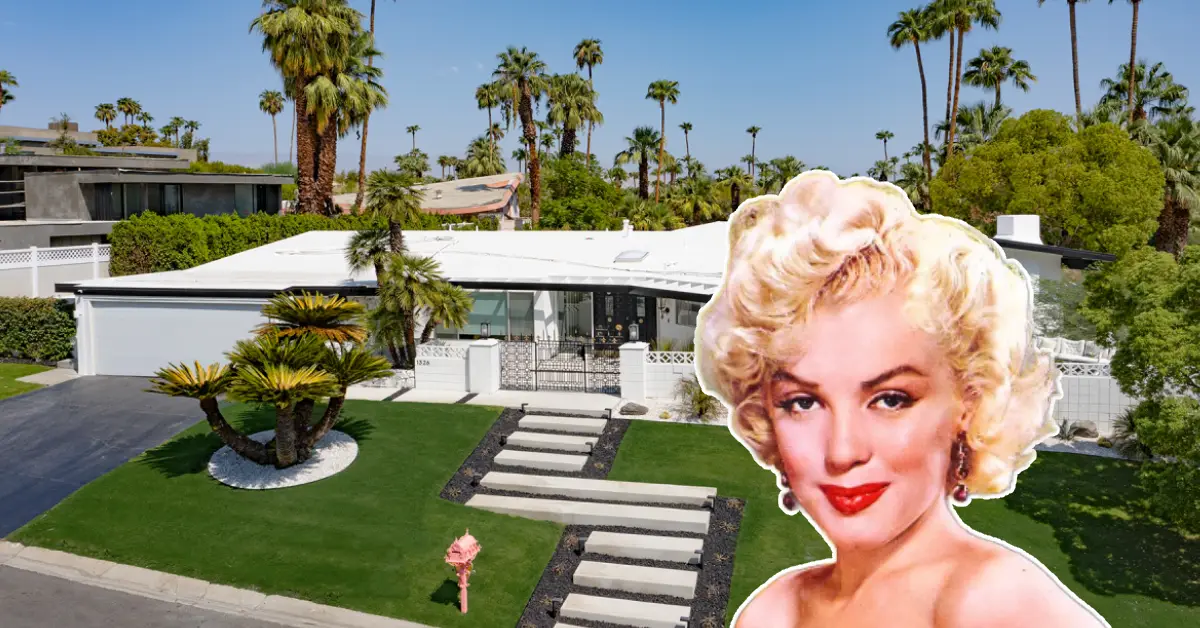
The Marilyn Monroe house, located at 12305 Fifth Helena Drive in Brentwood, Los Angeles, is the only residence the iconic actress ever owned. Monroe purchased the Spanish Colonial hacienda in February 1962 for approximately $75,000 — and was found dead there just six months later at age 36. The property last sold in 2023 for $8.4 million and was unanimously designated a Los Angeles Historic-Cultural Monument in June 2024, following a nationally publicized demolition controversy.
Who is Marilyn Monroe?
Born Norma Jeane Mortenson on June 1, 1926, in Los Angeles, Marilyn Monroe became one of the most commercially successful actresses of the 1950s, starring in films including Gentlemen Prefer Blondes (1953) and Some Like It Hot (1959). Behind the stardom was a life defined by loss from the very beginning. Her mother was frequently confined to an asylum, and Norma Jeane was raised by twelve successive sets of foster parents and spent time in an orphanage.
She changed her name to Marilyn Monroe, dyed her hair blonde, and signed her first studio contract with Twentieth Century Fox on August 26, 1946, earning $125 a week. From that modest starting point, she built one of the most recognizable personal brands in entertainment history. In their first runs, Monroe’s 23 movies grossed a total of more than $200 million, and her fame surpassed that of any other entertainer of her time.
Yet for all her fame, Monroe did not own a house until the last year of her life and had surprisingly few possessions. That fact makes the Brentwood property more than just real estate — it’s a window into who she was when the cameras stopped rolling.
Monroe starred in three movies released in 1953 and emerged as a major sex symbol and one of Hollywood’s most bankable performers. She won a Golden Globe for Some Like It Hot and was nominated for a BAFTA for The Prince and the Showgirl — achievements that reflected real craft, not just celebrity. She has influenced artists and entertainers such as Andy Warhol and Madonna, and remains a valuable brand in advertising, with her image licensed for hundreds of products.
The Story Behind the Marilyn Monroe House
Why She Bought It — and What It Meant to Her
According to Monroe biographers, Marilyn was urged by her psychologist to “put down roots” after three failed marriages to James Dougherty, Joe DiMaggio, and Arthur Miller. The Brentwood house wasn’t just an investment — it was a psychological necessity.
A document prepared for the Los Angeles Department of City Planning quoted Monroe’s housekeeper Eunice Murray, who said: “For a woman to buy a home alone in such an era could seem especially difficult. But it was even more difficult for a person to be without a home in those years. Especially someone like Marilyn, who had always felt deprived of a home.”
Monroe’s 1929 Spanish Colonial Revival home holds historical significance as the only home the Hollywood icon ever owned by herself, in a time when just 0.1% of single young women owned a home. She purchased it in early 1962 for $77,500 — a modest sum even then — and threw herself into making it feel like hers. She planted an herb garden with lemon trees and flowering plants, and the last check she ever wrote was for a white chest of drawers.
She also installed a hand-painted ceramic tile at the front entrance bearing the Latin phrase “Cursum Perficio” — “I have completed my journey.” It reads now as an epitaph she unknowingly wrote for herself.
Five months after purchasing the home, the Los Angeles Times ran the headline: “Marilyn Monroe Found Dead. Sleeping Pill Overdose Blamed.” She was 36 years old.
Architectural Details: A 1929 Spanish Hacienda in Brentwood
The one-story, Hacienda-style home sits on 2,900 square feet at the end of a quiet cul-de-sac off Carmelina Avenue. Built in 1929, the L-shaped property now consists of four bedrooms — only two existed when Monroe lived there — and three bathrooms.
The home was built by Richard and Martha Hunter, and may have been designed by their sons, Harbin and Asa, who were prominent architects in Los Angeles. The Spanish Colonial Revival style — red-tiled roofs, whitewashed stucco walls, arched doorways — was quintessential Southern California architecture of the era, and the home’s exterior has remained largely faithful to that original character.
A report prepared for the Department of City Planning noted the home’s exterior remains “largely intact and continues to reflect its character and condition at the time of Marilyn Monroe’s occupancy in 1962.”
Where Does Marilyn Monroe Live Now?
Marilyn Monroe passed away on August 4, 1962, at age 36. She does not live anywhere, but the physical address she called home in her final months — 12305 Fifth Helena Drive in Brentwood, Los Angeles, California — still stands. The property has been unoccupied since 2019, and as of 2025, remains in the hands of current owners Brinah Milstein and Roy Bank, who are engaged in an ongoing federal lawsuit against the City of Los Angeles over its landmark designation.
For those seeking to visit, the home is a private residence located in a quiet residential neighborhood. It is not open to the public. Fans regularly gather outside the property’s gates, which have themselves been modified over the decades. The LA City Council voted 12-0 to preserve the home and enshrine it as a Historic Cultural Monument in June 2024, meaning any significant alteration or demolition is now legally blocked.
Monroe’s final resting place is at Pierce Brothers Westwood Village Memorial Park in Los Angeles, where she was entombed at the Corridor of Memories. Joe DiMaggio was the only one of her ex-husbands to attend her funeral; he arranged the service and barred most of Hollywood, believing they held responsibility for her death.
Inside the Property: Layout, Design, and Distinctive Features
“Cursum Perficio” — The Latin Inscription That Still Haunts the Doorstep
The most emotionally loaded detail of the house isn’t a room or a square footage — it’s a line of ceramic tiles set into the front doorstep. The phrase “Cursum Perficio” translates to “I have completed my journey.” Monroe had it installed herself. Whether she meant it as a statement of arrival after years of rootlessness, or whether fate wrote the irony in retrospect, the phrase now reads like both a homecoming and a farewell.
It’s carved into the front porch of the modest hacienda on 5th Helena Drive where Marilyn Monroe’s life came to its tragic close in August 1962 — and fittingly, it doubled as the epigraph to the years-long legal wrangling over whether the Brentwood home should be deemed a historical landmark.
The Pool, the Garden, and the Citrus Grove
In the backyard, a free-form pool is adjacent to a citrus grove, and the guest house is on the left side of the driveway as seen from the front gate. Monroe’s bedroom opened directly onto the backyard and the pool — which biographers note she reportedly never used. She spent her time instead in the garden, where she planted herbs, lemon trees, and flowers.
Monroe is rumored to have fallen in love with the garden and would often spend calming afternoons there with her poodle. The sunroom, according to historical accounts, remains among the more architecturally intact areas of the home. A bookshelf was added over the years, but otherwise the space retains much of its original character.
The Battle to Save the House: From Demolition Threat to Historic Monument
The $8.35 Million Sale and the Demolition Permit
The modern chapter of the house’s story is as dramatic as anything from Monroe’s own life. In the summer of 2023, the property was sold in an off-market deal for $8.4 million to “Glory of the Snow Trust,” which immediately filed for a demolition permit.
Brinah Milstein and Roy Bank purchased the property and wanted to raze it and merge the lot with an adjacent estate. Their attorneys stated the house “has been unoccupied since 2019” and “is not in great shape.” The new owners argued that decades of renovations had erased any trace of Monroe’s physical presence from the structure — no furniture, no original fixtures, nothing bearing her direct mark.
The demolition permit triggered a public firestorm. In September 2023, a Change.org petition started, asking the city to turn the home into a museum. Thousands signed within days. Celebrities, historians, and preservationists spoke out. The cultural weight of the address proved far heavier than its legal status at the time.
The Unanimous City Council Vote That Changed Everything
Councilmember Traci Park introduced the proposal to designate the home as an LA landmark, stating: “We have an opportunity to do something today that should have been done 60 years ago. There is no other person or place in the city of Los Angeles as iconic as Marilyn Monroe and her Brentwood home.”
In June 2024, the LA City Council approved a motion in a 12-0 vote to preserve the home, preventing the current property owners from demolishing it.
The owners responded with a federal lawsuit, arguing the designation amounted to an unconstitutional government taking of private property without compensation. Their attorney said: “The city has effectively created a Marilyn Monroe Museum on private property and foisted the costs of that on the private property owners, because now they’re the ones that have to preserve and maintain it.”
In a ruling on September 8, 2025, Los Angeles Superior Court Judge James C. Chalfant rejected the legal challenge from the property’s owners, upholding the City Council’s designation of the home as a Historic Cultural Monument. The ruling is widely regarded as the final word on the matter.
What Is the Marilyn Monroe House Worth Today?
The property most recently changed hands for $8.4 million in an off-market sale in the summer of 2023. With the Historic Cultural Monument designation now legally locked in, the home’s market dynamics are complicated. Landmark status in Los Angeles restricts what owners can alter, demolish, or build — which typically reduces development potential but can increase the prestige value of historically significant properties.
Brentwood itself is one of Los Angeles’ most affluent residential neighborhoods, where comparable properties routinely trade between $5 million and $20 million depending on size, condition, and lot value. But no comparable truly exists for this address. A property tied directly to the life and death of one of the 20th century’s most globally recognized figures occupies its own category — simultaneously a real estate asset, a cultural artifact, and a piece of American mythology.
Only about 2% of designated Historic Cultural Monuments in Los Angeles currently represent women’s history, which adds further institutional significance to this address and its long-term legacy.
The Neighborhood: Brentwood, Los Angeles
Brentwood sits on the Westside of Los Angeles, bordered by Bel-Air to the east, Pacific Palisades to the west, and Santa Monica to the south. It’s one of the city’s most established affluent enclaves, known for wide tree-lined streets, proximity to the Getty Center, and a discreet residential character that attracts entertainment industry figures, executives, and old-money Angelenos alike.
The neighborhood’s appeal in 1962 was much the same — which is precisely why Monroe chose it. After years of hotel suites and rented apartments across New York and Los Angeles, Brentwood offered her the kind of quiet, private rootedness she’d never had. Fifth Helena Drive, a short cul-de-sac just off Carmelina Avenue, was — and remains — the sort of street where nobody bothers you.
That privacy, ironically, is now what makes the property’s landmark status complicated. Nearby residents have expressed concern about increased foot traffic from fans drawn to the site. The city has had to balance cultural preservation against the residential character of the surrounding neighborhood.
FAQs
Where is the Marilyn Monroe house located?
The Marilyn Monroe house is located at 12305 Fifth Helena Drive in Brentwood, Los Angeles, California 90049. It is in a quiet residential cul-de-sac off Carmelina Avenue.
Can you visit the Marilyn Monroe house?
No, the property is privately owned and not open to the public. People can only view it from outside the gate.
How much did Marilyn Monroe pay for her house?
She bought the home in 1962 for about $77,500. It sold in 2023 for around $8.4 million.
Why was the Marilyn Monroe house almost demolished?
In 2023, new owners planned demolition to combine the lot with another property. Public pressure led to its historic protection in 2024, stopping demolition.
Is the Marilyn Monroe house a landmark?
Yes, it was declared a Historic Cultural Monument in Los Angeles in 2024, which protects it from demolition.
Conclusion
The Marilyn Monroe house was never supposed to be a monument. It was supposed to be a beginning — the first private space Monroe ever truly owned, a quiet hacienda where she planted herbs, looked after her poodle, and wrote checks for furniture she’d never get to arrange. It lasted six months as her home. It has lasted over sixty years as something the world refuses to let go of.
That refusal is remarkable when you consider what the property actually is: a modest, 2,900-square-foot Spanish hacienda in a residential neighborhood. No grand estate. No sweeping grounds. Just a house, a pool, some lemon trees, and a Latin phrase on the doorstep about completing a journey.
What the public fought for — and won — in 2024 and 2025 was not a glamorous relic. It was recognition that some places earn their preservation not through architectural grandeur, but through the human weight of what happened within their walls. The Marilyn Monroe house is now protected. Whether it ever becomes a museum, remains a private property, or exists simply as an address on a quiet cul-de-sac that people drive slowly past — it stands. And for now, that is enough.