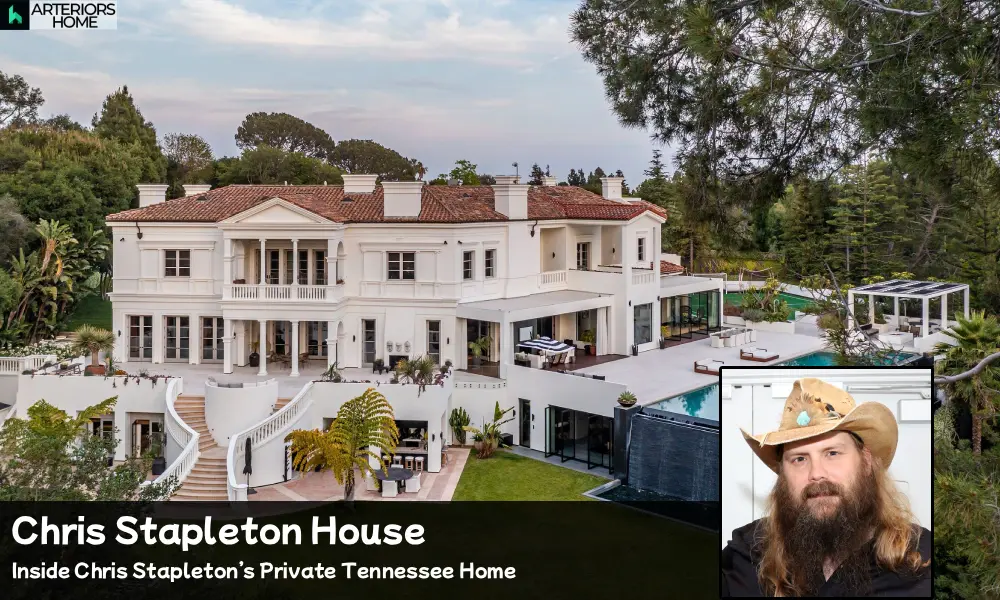
The Chris Stapleton house is one of the most talked-about celebrity estates in Tennessee — a sprawling 325-acre private compound near Franklin and Leiper’s Fork that blends Southern ranch architecture with serious luxury. Stapleton purchased this rural-property investment back in 2017 for around $5.6 million, and today the estate carries an estimated value of $8M to $12M, land and improvements combined.
For a Grammy-winning artist who has built his reputation on authenticity and family-first values, this property is the perfect physical expression of his lifestyle. Far from the flashy urban mansions you’d expect from a touring-musician schedule of his scale, this is a privacy-first compound design that prioritizes peace, space, and roots over show.
In this full estate tour, we break down everything — from the exterior architecture and interior aesthetics to the outdoor oasis, investment value, and what the neighborhood looks like in 2026.
Who Is Chris Stapleton?
Chris Alvin Stapleton was born on April 15, 1978, in Lexington, Kentucky. He moved to Nashville in his early twenties and spent years as a behind-the-scenes songwriter before his debut solo album Traveller turned him into a global country-rock icon almost overnight in 2015.
By 2026, Stapleton is one of Nashville’s most bankable live performers — a multiple Grammy, ACM, and CMA winner who consistently sells out arenas and stadium tours worldwide. His discography spans Traveller, From A Room Vol. 1 and 2, and Starting Over, each one building on the Southern rock and blues-drenched sound that made him famous.
Away from the stage, he is deeply family-oriented. He and his wife Morgane Stapleton have five to six children and live a deliberately low-profile celebrity lifestyle — boots-and-denim, anti-celebrity-glam, and firmly planted in rural Tennessee. His philanthropy focus centers on music-education and rural-community programs, adding a Nashville-adjacent songwriter depth to his public image that goes well beyond music.
| Field | Details |
| Full Name | Chris Alvin Stapleton |
| Date of Birth | April 15, 1978 |
| Place of Birth | Lexington, Kentucky |
| Age in 2026 | 48 years old |
| Nationality | American |
| Religion | Christian |
| Current Residence (2026) | Franklin, TN / Leiper’s Fork Estate |
| Primary Residence Value | ~$8M–$12M (land + improvements) |
| Net Worth (2026) | ~$25M–$35M |
| Occupation | Singer, songwriter, guitarist |
| Genres | Country, Southern rock, blues |
| Notable Albums | Traveller, From A Room, Starting Over |
| Top Awards | Multiple Grammys, ACMs, CMAs |
| Height | 6 ft 0 in (approx) |
| Marital Status | Married to Morgane Stapleton |
| Children | 5–6 children |
| Philanthropy Focus | Music-education, rural-community programs |
| Public Image Style | Low-key, boots-and-denim, anti-celebrity-glam |
Chris Stapleton House – Detailed Specifications & Architecture
The Chris Stapleton house sits on a 325-acre private gated estate outside Franklin, Tennessee — one of the largest celebrity-owned parcels in the region. The main residence is a multi-section ranch-core architecture build spanning several thousand square feet, with a low-profile façade that deliberately blends into its wooded, rolling landscape rather than demanding attention from the road.
The structure mixes natural-materials cladding — think exposed stone, reclaimed wood, and matte finishes throughout — with modern-built additions that accommodate a growing family and a working musician’s needs. The rural compound layout includes not just the main house, but outbuildings, a private recording studio, and multiple outdoor entertainment zones spread across the acreage.
This isn’t a property built for Instagram. It’s built for living — and for the kind of privacy you simply cannot buy in Nashville proper.
| Feature | Chris Stapleton Estate (Franklin, TN) |
| Total Square Footage | Several thousand sq ft (multi-section) |
| Number of Bedrooms | 4–6+ (family-oriented, multiple kids) |
| Full Bathrooms | 4–5+ (primary suite + family wing) |
| Floors / Stories | 1–2 main levels, plus basement / loft areas |
| Garage Capacity | Multi-car garage (2–4+ bays) |
| Pool Type | Large outdoor pool with casual lounge area |
| Front Landscaping | Rolling lawn, mature trees, native plantings |
| Backyard Features | Entertainment pavilion, smoker grill, horse-friendly zones |
| Year Built / Renovation | Main structure 2000s–2010s; 2017 purchase / upgrades |
| Total Acreage | 325 acres (land + buffer zones) |
Where Does Chris Stapleton Live Now?
As of 2026, Chris Stapleton lives on his private 325-acre estate in Franklin, Tennessee, near the small artistic community of Leiper’s Fork. This area sits roughly 25 to 30 miles southwest of downtown Nashville — close enough to the city for studio work, touring logistics, and airport access, but far enough to feel like an entirely different world.
Franklin and Leiper’s Fork operate as an affluent, semi-rural enclave with strict zoning, minimal light pollution, and a strong culture of horse-property zoning and large-lot preservation. You won’t find new subdivisions carved into these hills. What you will find is rolling farmland, gated driveways disappearing into tree lines, and the quiet that serious musicians and producers pay a premium to protect.
The 325-acre parcel almost functions like a private musician compound rather than a standard suburban lot. The long driveway alone keeps the main house invisible from any public road. Dense tree-buffered lots and natural topography handle the rest. Stapleton’s property-as-retreat framing is genuinely supported by the geography here — this isn’t a performance of privacy, it’s the real thing.
Exterior Design & Curb Appeal
From the moment you turn off the public road and onto the estate’s long driveway, the design philosophy becomes clear: this is a property that respects the land it sits on. The front-yard approach is lined with mature trees and native plantings that create a natural, almost pastoral corridor before the main house even comes into view.
The façade itself leans into ranch-style humility. There’s no grand column entry, no oversized glass curtain wall, no architectural statement for the sake of a statement. Instead, the exterior uses natural-materials cladding — wood, stone, and earth tones — that feel grown-in-place rather than constructed. It’s the visual language of a Southern ranch architecture tradition that values permanence over flash.
Franklin-style zoning actively encourages this kind of low-profile, land-heavy design. Large setbacks, tree-preservation requirements, and rural-corridor overlays all push development toward the understated. For a musician who has publicly rejected celebrity-glam culture, the exterior of the Chris Stapleton house is a near-perfect architectural reflection of his values.
Interior Aesthetics & Flooring
Step inside and the warm, rustic-modern aesthetic continues without missing a beat. The interior finishes lean heavily on exposed wood beams, stone accent walls, and matte surfaces that absorb light rather than bounce it. These are materials built for a family — durable, warm, and honest.
Hardwood or engineered-wood flooring runs through the main living areas, giving the open-plan living spaces a cohesive, grounded feel. Bedrooms likely transition to softer carpet, a practical choice when you have five-plus children running through the house. The overall palette skews neutral and earthy, consistent with a country-music-heritage location aesthetic that doesn’t chase trends.
The layout is designed with both family life and entertaining in mind. Wide corridors, flexible living zones, and a multi-level floor plan create natural circulation between private and social spaces — important for a home that needs to accommodate a touring-musician schedule’s irregular rhythms of quiet and crowd.
Master Suite Sanctuary
The primary suite in the Chris Stapleton house operates as a self-contained retreat within the larger estate. It likely includes a generously sized bedroom, a sitting area for unwinding post-tour, a full en-suite bathroom with high-end fixtures, and a walk-in primary-closet system with custom storage built for two working musicians’ wardrobes and gear.
Private access to an outdoor patio or garden area would be consistent with the estate’s privacy-first compound design philosophy, giving the primary suite its own connection to the outdoors without passing through shared family spaces. For a performer who spends months on the road, having a true sanctuary to return to isn’t a luxury — it’s a necessity.
This section of the home weaves together the lifestyle meaning of the whole property: a record-breaking career that funds a personal life deliberately kept away from public scrutiny, built on land that provides genuine buffer from the outside world.
Outdoor Oasis – Pool, Garage & Gardens
The outdoor areas of the estate are where the 325 acres really start to earn their keep. The outdoor pool with lounge deck is sized for family use — wide, relaxed, and oriented toward the views rather than toward any road or neighbor. The surrounding decking and lounge seating keep things casual and low-maintenance, consistent with a home entertainment pavilion mentality rather than a resort-style showpiece.
The multi-car garage likely runs to two to four bays minimum at this estate scale, with attached workshop or storage capacity for instrument cases, trucks, ATVs, and the general logistical infrastructure of a touring household. A covered outdoor grill area and smoker setup fit naturally on a property this size, where evening gatherings can sprawl across the lawn without any concern for proximity to neighbors.
The front and back gardens balance lawn space for children with horse-friendly zones and natural buffers that increase privacy at every boundary. The equestrian center and trails on the property reflect Leiper’s Fork’s broader culture as a horse-property community — this isn’t a concession to zoning, it’s a genuine lifestyle feature of the rural compound layout.
Nearest Celebrities & Neighborhood Context
Leiper’s Fork and the wider Franklin corridor have quietly become a country-music-elite enclave over the past decade. The area draws in songwriters, producers, and A-list artists who prioritize privacy and land over proximity to the Nashville spotlight. It’s the kind of place where you can spend a morning riding horses, an afternoon in a private recording studio, and an evening around a fire pit without a single camera or fan in sight.
Several high-profile country and Americana artists own large-lot estates in the area, their properties reflecting the same blend of privacy-first design and songwriter-friendly studio space that defines the Stapleton compound. This concentration of music-industry wealth and talent creates strong entity-cluster signals for the entire corridor — a self-reinforcing halo of prestige that benefits every property in the area.
For real estate purposes, that celebrity-association halo translates directly into demand and price stability. A buyer acquiring any significant parcel in this corridor isn’t just buying land — they’re buying proximity to one of the most exclusive informal communities in American music.
Investment Value – ‘Hold’ vs. ‘Flip’ in 2026
From a real estate investment perspective, the Franklin and Leiper’s Fork market sits in a genuinely unusual position in 2026. Demand for large-lot, privacy-oriented properties in this corridor has remained structurally strong, supported by Nashville’s continued growth as a finance, healthcare, and entertainment hub — all of which push high-net-worth buyers outward into the surrounding countryside.
The Chris Stapleton house represents a classic long-term hold property for three core reasons. First, land scarcity: 325-acre parcels within 30 miles of Nashville are essentially irreplaceable. You cannot manufacture more of them. Second, the celebrity-association halo provides a prestige premium that is difficult to quantify but very real in buyer psychology. Third, the compound’s buffer zones — all that acreage of wooded and farmland screening — are nearly impossible to replicate in any new construction scenario.
On the tax side, farmland and conservation-style land use can support highly tax-efficient holding strategies that reduce the annual carrying cost of a property at this scale. Combined with low-profile appreciation driven by Nashville’s long-run growth trajectory, this estate fits the profile of a rural-property investor’s dream hold: illiquid, yes, but deeply defensible in value over any meaningful time horizon.
Frequently Asked Questions
Can you see Chris Stapleton’s house from the street?
No. The main residence is heavily buffered by trees and natural topography. The long-driveway access and dense tree-buffered lots mean the house has minimal — effectively zero — public visibility from any road.
When did Chris Stapleton buy the Franklin property?
He purchased the 325-acre estate near Leiper’s Fork around 2017 for roughly $5.6 million. Since then, upgrades and market appreciation have pushed the estimated value into the $8M–$12M range.
How big is the Chris Stapleton house?
The main residence spans several thousand square feet across one to two main levels, with additional outbuildings, a private recording studio, and support structures spread across the broader estate.
Does Chris Stapleton have a pool and backyard pavilion?
Yes. The estate includes a large outdoor pool with a lounge area and a covered entertainment pavilion with a grill setup and seating — perfectly scaled for family gatherings on the property’s expansive grounds.
Is the house in a gated community?
No — it sits on a private 325-acre parcel rather than a traditional gated community. The privacy comes from natural screening, long driveway access, and the sheer scale of the land buffer rather than a shared community gate.
Are there horses or equestrian facilities on the property?
Yes. The location includes equestrian facilities and trails consistent with the broader Leiper’s Fork culture of horse-property zoning. The scale of the acreage supports private equestrian use rather than commercial stable operations.
Is the Chris Stapleton house for sale in 2026?
As of 2026, the Franklin estate appears to remain Stapleton’s primary residence and is not publicly listed for sale. Separate coastal properties — including a previously reported Inlet Beach property — have sold separately.
Final Thoughts
The Chris Stapleton house in Franklin, Tennessee is more than a celebrity real estate story. It’s a case study in how a genuinely private, family-oriented musician builds a life that matches his values — not just his income. The 325-acre private gated estate, with its Southern ranch architecture, private recording studio, outdoor pool with lounge deck, and horse-friendly zones, is a physical statement of everything Stapleton stands for as an artist and as a person.
From an investment standpoint, it’s a textbook rural-property investor hold: irreplaceable acreage, celebrity-association halo, tax-efficient land use, and proximity to one of America’s fastest-growing metro areas. From a lifestyle standpoint, it’s simply one of the finest examples of what a country-music-heritage location can look like when it’s built by someone who actually understands the land.
Whether you’re here for the house tour, the real estate analysis, or simply the story of a musician who got everything right — the Chris Stapleton house in Leiper’s Fork is a property worth knowing about.
Stay connected with ArteriorsHome for exclusive insights into celebrity homes, luxury interiors, and cutting-edge architecture. Subscribe to receive expertly curated design inspiration, real estate trends, and in-depth features delivered directly to your inbox—helping you stay ahead in modern living and elevated home aesthetics.