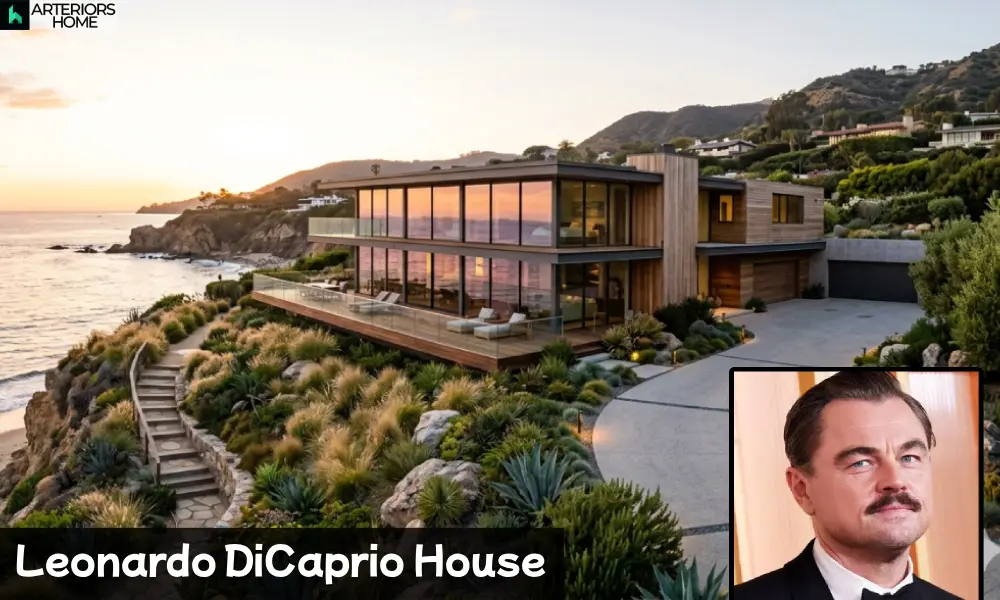
Leonardo DiCaprio’s Malibu beach house is a $23 million oceanfront estate on the Pacific Coast, featuring sleek contemporary design, floor‑to‑ceiling windows, and private beach access. The property reflects his taste for secluded, high‑end homes with a focus on comfort, views, and architectural elegance.
Beyond Malibu, Leonardo DiCaprio owns several luxury properties, including a large Hollywood Hills compound and a Spanish Colonial home in Los Feliz. His real‑estate portfolio blends privacy with sustainability, mirroring his environmental values while maintaining the refined lifestyle expected of a top Hollywood star.
Inside Leonardo DiCaprio’s Malibu Beach House
Nestled within a tiny, gated enclave of just five homes along Pacific Coast Highway, the Leonardo DiCaprio Malibu beach house is unlike any typical celebrity listing. The property sits in a secluded bluff community known as El Sol, a natural cove where rugged cliffs meet the open Pacific. It’s an address that rarely comes to market — and when it does, it commands serious attention.
Built in 2005, the multi-level residence spans roughly 3,300 square feet and offers four bedrooms and five bathrooms across its thoughtfully designed floors. The architectural style leans heavily into contemporary coastal design — glass walls, clean horizontal lines, warm wood finishes, and an aesthetic that feels at once sophisticated and effortless. The structure is not loud or flashy in the way that some celebrity homes tend to be. Instead, it feels curated, calm, and deeply connected to its oceanfront surroundings.
The approach to the home is itself an experience. A private gated street leads down from PCH, offering immediate separation from the outside world. As the listing itself described it, the location offers a rare combination of “tranquility and an indoor/outdoor lifestyle” that is almost impossible to replicate elsewhere along this stretch of coastline. High ceilings greet visitors upon entry, while expansive windows frame uninterrupted views of the Pacific from nearly every room. The open-plan layout of the main living areas allows natural light to flood the space throughout the day, shifting from crisp morning brightness to warm amber tones as the sun dips toward the horizon each evening.
Layout and Interior Features
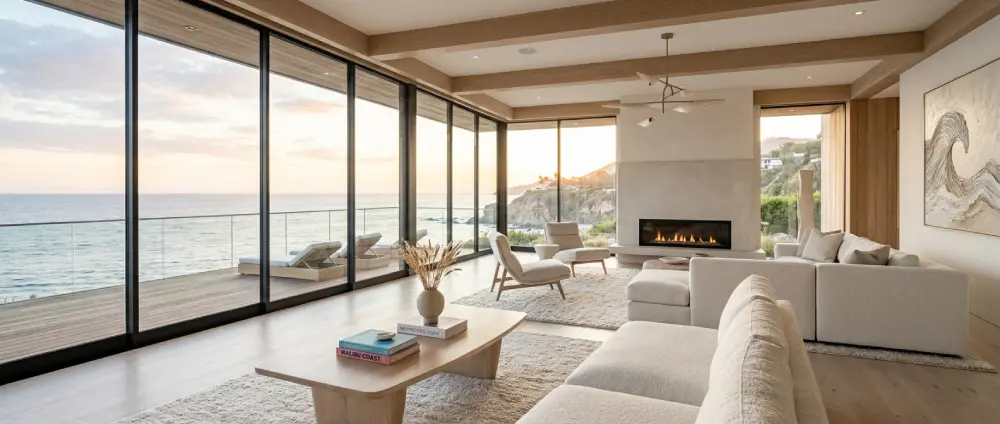
Step inside this Malibu oceanfront estate and the attention to detail becomes immediately apparent. The main floor centers around an open-concept living room, dining area, and chef’s kitchen finished with premium materials. Quartz countertops, top-tier appliances, and sleek cabinetry define the culinary space, which flows naturally into the dining area and then out onto the terraces beyond.
According to listing details, the home is outfitted with “top-of-the-line finishes and fixtures” throughout, with gleaming hardwood floors and walls of glass running across the primary living spaces. The minimalist interior approach — neutral tones, clean lines, and understated decor — allows the ocean view to remain the undisputed focal point in every room.
The primary suite is arguably the crown jewel of the residence. Positioned to capture sweeping ocean vistas, this master bedroom comes with its own fireplace, which adds a surprisingly cozy dimension to the otherwise breezy coastal setting. An oversized walk-in closet provides ample storage, while the ensuite bathroom leans into full spa territory: a freestanding soaking tub, a steam shower, and premium fixtures throughout.
The secondary bedrooms each follow a similarly thoughtful approach. Designed with guests or family in mind, each room carries its own ensuite setup and generous proportions. The overall layout feels less like a weekend rental and more like a full-time retreat — one that has been deliberately designed for comfortable, extended stays.
Smart-home elements are woven throughout the property, including integrated climate control, security systems, and automated lighting — modern conveniences that remain invisible until needed, preserving the home’s serene, low-tech atmosphere.
Outdoor Space and Beachfront Living
If the interior of this Malibu beach house impresses, the outdoor experience is truly something else. The property features multiple balconies and open patios that extend the living spaces outward toward the ocean, accessible through full glass doors that create a genuinely seamless indoor-outdoor flow throughout the year.
Private steps lead directly from the property down to El Sol Beach — described in the listing as one of the most coveted and private stretches of sand anywhere in Malibu. With only a handful of homes sharing this beach access, the sense of seclusion is extraordinary. Unlike the more crowded and heavily trafficked sections of Carbon Beach or Broad Beach, El Sol maintains a wild, natural character that’s increasingly rare along this coastline.
The outdoor amenities extend well beyond basic beach access. The estate includes a sauna, a hot tub, and an outdoor fire pit — thoughtful touches that make the exterior just as livable as the interior on cooler evenings. Lush, low-maintenance coastal landscaping wraps around the property’s edges, softening the architecture without obstructing the views.
The real magic of this outdoor setting, however, might simply be the daily experience of watching the Pacific from your own terrace. As the property listing poetically noted, this is a place where you can observe dolphins playing just offshore — a sight that the listing itself called “so rare and special.” Add in the uninterrupted sunsets over the water, the sound of waves below, and the complete absence of traffic noise or crowds, and it’s not hard to understand why properties in this particular enclave rarely hit the open market.
Price, Investment, and Market Context
The financial story behind the Leonardo DiCaprio Malibu waterfront property is one of textbook coastal real estate timing. DiCaprio acquired the home in July 2021 for $13.75 million through an LLC managed by his longtime business advisor — a transaction completed quietly in an off-market deal.
| Category | Details |
|---|---|
| Purchase Year | 2017 |
| Purchase Price | ~$4 million |
| Initial Listing Date | July 2025 |
| Initial Asking Price | $23 million |
| Estimated Potential Gain | ~$10 million |
| Initial Rental Price | $65,000/month |
| Reduced Asking Price | $19.99 million |
| Reduced Rental Price | $59,000/month |
| Current Status | Listing withdrawn |
This pattern is consistent with how Malibu’s ultra-luxury beachfront segment behaves. Properties along the most coveted stretches of Pacific Coast Highway rarely find buyers quickly at top-dollar prices; they tend to attract a narrow pool of high-net-worth buyers with extremely specific requirements. Yet the underlying value proposition remains strong: oceanfront land in Malibu is genuinely finite, and long-term appreciation has historically rewarded patient sellers. DiCaprio’s potential margin here — even at a reduced sale price — would still represent one of the stronger short-term returns in Malibu’s recent history.
Leonardo DiCaprio House in Malibu: A Luxury Beachfront Icon
What truly distinguishes the Leonardo DiCaprio house in Malibu from comparable celebrity properties is not its price tag alone — it’s the combination of factors that makes a property like this nearly impossible to replicate.
First, there is the matter of location. The El Sol cove enclave sits within one of the most private stretches of the entire Pacific Coast Highway corridor. There are no more than five homes with direct sand access in this pocket. When one of those properties becomes available, it represents a genuine rarity in a market defined by scarcity.
Second, there is the design. The 2005 construction reflects a period when coastal modernism had matured — where the goal was no longer to impose architecture on the landscape, but to dissolve the barrier between built space and natural environment. The glass walls, open decks, and natural material palette of this home achieve exactly that.
Third, and perhaps most relevant to DiCaprio personally, there is the sustainability dimension. The estate’s integration with its coastal environment — minimal hardscape, native-friendly planting, energy-efficient systems — aligns with the actor’s long-standing environmental values. For DiCaprio, a home is never merely a status symbol. It is, ideally, a structure that sits lightly on the land.
Leonardo DiCaprio’s Other Homes and Real-Estate Portfolio
The Malibu beach house is just one chapter in a remarkably expansive real estate story. Over three decades, DiCaprio has assembled a portfolio that spans continents and architectural styles, with a total estimated value that some analysts place above $100 million.
His crown jewel is the Hollywood Hills compound in the Bird Streets neighborhood above the Sunset Strip — a multi-parcel, five-acre estate that has grown steadily since the 1990s. It began with the purchase of two adjoining homes for roughly $4 million, one of which was formerly owned by Madonna. Over the years, DiCaprio expanded the compound through the acquisition of neighboring parcels, adding a basketball court, an infinity pool, a wine cellar, and an underground garage. The entire spread now covers five parcels with over 15,000 combined square feet of living space and four separate pools.
In December 2021, he branched into Beverly Hills, acquiring a graceful 1930s traditional home for $9.9 million — a five-bedroom, six-bathroom property with cathedral ceilings, a wrought-iron spiral staircase, and a pool tucked behind mature olive trees. In 2014, DiCaprio purchased a storied Palm Springs estate originally designed by architect Donald Wexler for Dinah Shore — a 7,000-square-foot midcentury masterwork that he has since made available as a high-end vacation rental at roughly $3,750 per night.
He also purchased a Spanish Colonial-style property in the Los Feliz neighborhood — formerly owned by Jesse Tyler Ferguson — reportedly as a home for his mother, Irmelin. On the East Coast, DiCaprio holds multiple apartments at the eco-forward Riverhouse development in Manhattan’s Battery Park City. And perhaps most ambitiously, he owns Blackadore Caye, a 104-acre private island in Belize, which he has announced plans to develop into a fully renewable-energy-powered eco-resort.
The thread connecting all of these properties is consistent: DiCaprio gravitates toward architecturally distinctive, secluded, and sustainably oriented homes. He buys thoughtfully, holds patiently, and sells strategically — a pattern that has served him exceptionally well over the course of his property-investment career.
Where Does Leonardo DiCaprio Live Now?
Despite holding properties from Malibu to Manhattan and a private island in Belize, Leonardo DiCaprio’s primary home base remains firmly in Los Angeles. Specifically, he is understood to reside principally within his Hollywood Hills compound in the Bird Streets neighborhood — the same Bird Streets enclave above the Sunset Strip that has served as the anchor of his real estate life for more than two decades.
The five-acre, multi-building estate in Hollywood Hills underwent significant renovation and eco-friendly upgrades in recent years, including the installation of solar panels across the roof and the replacement of much of the traditional landscaping with drought-resistant cactus and native plants — a direct reflection of DiCaprio’s environmental convictions. The hilltop compound now boasts five bedrooms, eight and a half bathrooms, a spa built into the hillside, and jaw-dropping views across Los Angeles.
The Malibu oceanfront property, by contrast, functions more as a high-end investment and occasional retreat rather than a full-time residence. DiCaprio was reportedly uncertain whether he ever lived in the El Sol home full-time, and the property was initially listed for rent before being offered for sale — suggesting it served primarily as a financial asset within his broader portfolio.
His lifestyle tends to shift between different properties depending on filming schedules, season, and personal preference. Whether he’s finishing a production in Los Angeles, retreating to Palm Springs, or spending time between his various holdings, DiCaprio manages his real estate holdings with the same strategic attention he brings to selecting film projects.
Sustainability, Privacy, and Lifestyle
Leonardo DiCaprio’s approach to real estate is inseparable from his broader values. As one of Hollywood’s most prominent environmental advocates — and the founder of the Leonardo DiCaprio Foundation, which funds wildlife protection and ecosystem restoration — he has consistently prioritized eco-conscious design across his property portfolio.
At the Hollywood Hills compound, recent aerial photographs revealed an estate that has been genuinely transformed. Solar panels cover the roof. Drought-tolerant cactus and native plantings have replaced traditional lawns. Water-conserving irrigation systems manage the landscaping. These aren’t cosmetic gestures — they reflect a serious commitment to reducing the environmental footprint of a sprawling multi-building estate.
Privacy is another constant across DiCaprio’s property choices. Whether it’s a gated enclave on the Pacific Coast Highway, a walled compound above the Sunset Strip, or a remote island in Belize, each property he owns prioritizes seclusion. This preference extends to how he uses these homes: not for high-profile Hollywood parties or media appearances, but for quiet downtime, creative work, and hosting small groups of close friends and family.
His lifestyle is, in many ways, the opposite of what popular imagination might expect from one of the world’s biggest movie stars — deliberately low-key, environmentally intentional, and architecturally thoughtful.
Celebrity Real Estate Trends and DiCaprio’s Influence
Leonardo DiCaprio’s real estate choices don’t exist in a vacuum — they reflect, and in some cases actively shape, broader trends in the luxury property market. His long-standing preference for Malibu, Hollywood Hills, and architecturally significant homes has helped sustain interest in these neighborhoods as the pinnacle addresses for A-list talent.
Malibu, in particular, owes a portion of its enduring mystique to the concentration of celebrities who have built and bought there over the decades. When a high-profile name like DiCaprio lists a property — even if it ultimately comes off the market without selling — it generates international media coverage that reinforces Malibu’s status as one of the world’s most desirable coastal addresses. Luxury rentals in the area range from $40,000 to well above $100,000 per month, and oceanfront land commands premiums that few other California markets can match.
Beyond market dynamics, DiCaprio’s visible embrace of eco-friendly design has contributed to a broader shift in how ultra-high-net-worth buyers think about luxury homes. Solar panels, drought-resistant landscaping, and energy-efficient systems are no longer seen as compromises — they are increasingly markers of sophisticated, forward-thinking ownership. In this sense, DiCaprio’s portfolio offers a blueprint that other celebrity investors and wealthy buyers have quietly begun to follow.
Conclusion
The Leonardo DiCaprio Malibu house is far more than a headline-grabbing celebrity listing. It is a carefully considered piece of coastal architecture, positioned within one of California’s most genuinely exclusive enclaves, held by one of Hollywood’s most strategically minded real estate investors.
From the private steps leading down to El Sol Beach, to the spa-like primary suite overlooking the open Pacific, every element of this estate reflects a commitment to quality, seclusion, and long-term value. And whether DiCaprio ultimately sells, rents, or holds this property for another decade, his real estate decisions will continue to capture the imagination of anyone fascinated by the intersection of celebrity, architecture, and the enduring allure of the California coastline.